Trust is not one thing
Trusting and trustworthy are two separate behaviours, not one spectrum. A team can be safe to share in and still not share. Diagnosing which axis is broken leads to a completely different coaching move.
The team where trust surveys looked fine
The pulse surveys said safety was present. Leaders had run the workshops. Working agreements covered honesty. And yet the early signals still weren't being raised — not in standups, not in retrospectives, not in one-to-ones. Problems arrived fully formed, long past the point where they were cheap to address.
The coach had been working on safety as if it were a single variable. It is not. Johnson's two-axis trust model makes the distinction precise: trusting and trustworthy are orthogonal behaviours, not opposite ends of one spectrum. Either can fail independently. Coaching the wrong axis makes things worse.
The two axes
Trusting behaviour is openness: the willingness to self-disclose, share incomplete thinking, admit uncertainty, and place yourself at risk of being known. A member who raises early signals, asks for help before they need to, or says "I don't know yet" is exhibiting trusting behaviour.
Trustworthy behaviour is acceptance: responding to others' openness with support, curiosity, and non-exploitation. A member who receives a concern without weaponising it, who asks a genuine question before offering an opinion, who protects a speaker's exposure — that is trustworthy behaviour.
Both are required for trust to function. You can be willing to share (trusting) and receive no acceptance (low trustworthy). You can be accepting (trustworthy) and work with members who won't disclose (low trusting). The psychological safety literature tends to treat these as one variable. The two-axis model separates them — which is what makes it diagnostic.
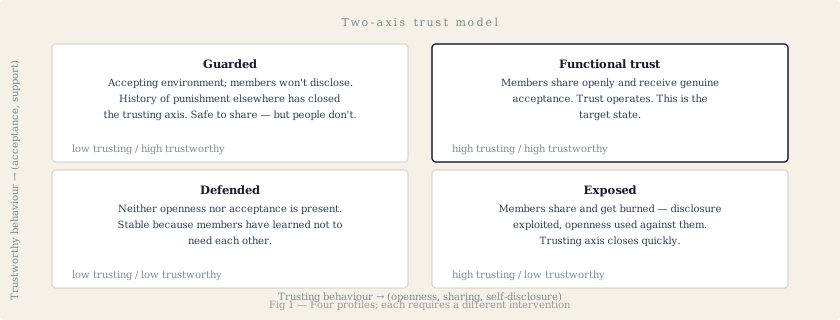
Four trust profiles
High trusting / High trustworthy
Members share openly and receive acceptance. Trust functions. This is the target state.
High trusting / Low trustworthy
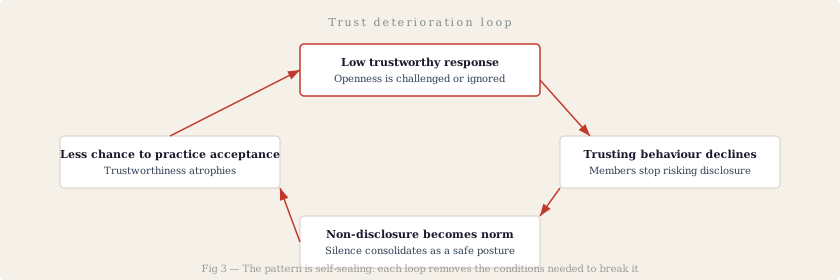
Members share and get burned — challenge used as weapon, disclosure exploited, openness punished. People stop risking.
Low trusting / High trustworthy
The environment is accepting and supportive, but members won't risk disclosure. History of punishment elsewhere has closed the trusting axis.
Low trusting / Low trustworthy
Neither openness nor acceptance is present. Defended and closed. Usually stable — members have learned not to need each other.
What breaks on each axis
The trusting axis breaks under: a history of openness being punished — past experience in this or a previous team where disclosure was exploited; performance goal orientation that makes vulnerability a liability; unclear norms about what level of self-disclosure is acceptable here. The member is willing to share in principle but has learned that sharing is costly.
The trustworthy axis breaks under: competitive team structure where others' problems become opportunities; leader behaviour that processes shared information in ways that disadvantage the sharer; norms that reward critique and certainty over curiosity and support. The environment punishes openness after the fact, which closes the trusting axis of every member who witnesses it.
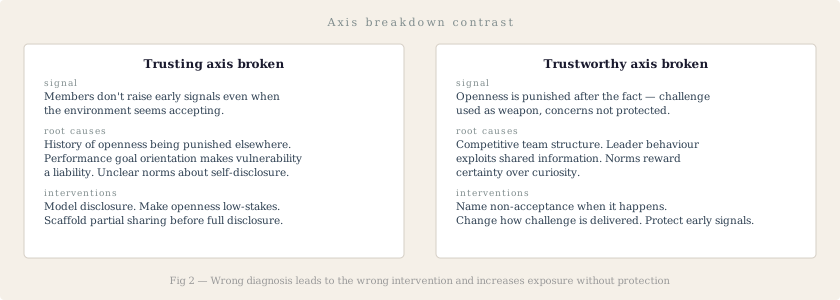
Different interventions for each axis
When the trusting axis is broken — when members won't disclose even though the environment is accepting:
Model disclosure yourself — share something incomplete or uncertain before asking others to.
Make openness low-stakes in design — start with professional uncertainty, not personal vulnerability.
Scaffold early partial sharing — ask for works-in-progress, not finished thinking.
When the trustworthy axis is broken — when the environment doesn't protect or accept openness:
Name non-acceptance when it happens: 'I notice what just happened there — the concern was raised and the conversation moved on.'
Change how challenge is delivered: curiosity first, critique second.
Create explicit protection for early signals — publicly reward raising something before it becomes a problem.
The coach's own profile
Coaches who are highly trustworthy but not trusting model acceptance without reciprocal vulnerability. The team learns that it is safe to share with the coach but sees no evidence that sharing costs the coach anything. This can produce a dependency where the coach carries disclosures that never return to the team.
Coaches who are trusting but working in low-trustworthy teams become the carrier of things the team cannot yet hold. Their openness goes unmatched and eventually costs them credibility. Neither profile is sustainable. The two-axis model applies to the coach as much as to the team.
Continue Exploring
Go deeper into the work
The Book
The Art of Creating Self-Organizing Teams
The full framework behind this article — contracting, team dynamics, and practical coaching tools for every stage of the journey.
Companion Toolkit
Resistance Radar & Resilience Scorecard
Practical tools for mapping resistance patterns and measuring whether interventions increased capacity — not just compliance.
TA for Agile
Co-creative TA in Agile Contexts
Ego states, psychological contracts, group imago, and the relational concepts that underpin this article — applied to real teams.