Coaching Online Is Not Coaching With Less WiFi: Virtual Teams, Anxiety, and What the Platform Cannot Hold
Remote and hybrid teams are not just co-located teams with a technology constraint. They are structurally more anxious — by conditions that group analysts have been able to name since the 1950s. Most of what gets labelled as a communication problem, an engagement problem, or a remote-working problem is an anxiety problem. The platform did not create it. The platform just removed what was containing it.
Compliant, not generative
The team is remote. The retrospective runs on time, uses a digital board, produces action items. The coach has figured out how to run the same session they used to run in person. Three months in, the coach notices: the team is more compliant, less generative. Everyone says the right things. Nothing surprising ever happens.
Something is missing and it has nothing to do with tools. The coach has the right platform, the right templates, the right facilitation techniques. What they do not have is the room. And the room, it turns out, was doing more work than anyone noticed while they were in it.
What group analysts knew in the 1950s
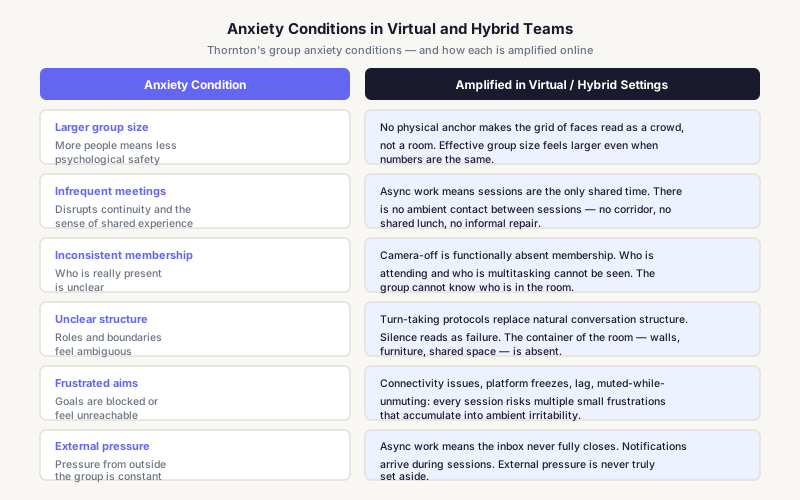
Thornton catalogues the conditions that produce anxiety in groups: larger group size, infrequent meetings, inconsistent membership, absence of clear structure, frustrated aims, and external pressure. These were identified through decades of clinical group work — long before the internet, long before the video call, long before the distributed team.
What is striking about this list is how precisely it describes the virtual and hybrid working environment. No physical anchor makes the effective group size feel larger — the grid of faces on a video call reads as crowd rather than room. Camera-off meetings are functionally inconsistent membership: the coach cannot know whether the person behind the black square is present or absent in any meaningful sense. Connectivity issues frustrate aims in the most literal way. Async work means external pressure is constant, never fully set aside even during a synchronous session.
This is not a technology problem. These are structural anxiety conditions, and the virtual environment maximises all of them simultaneously. The team that feels vaguely uneasy online is not being irrational. It is responding accurately to an environment designed, without anyone intending it, to produce anxiety.
What is genuinely lost online
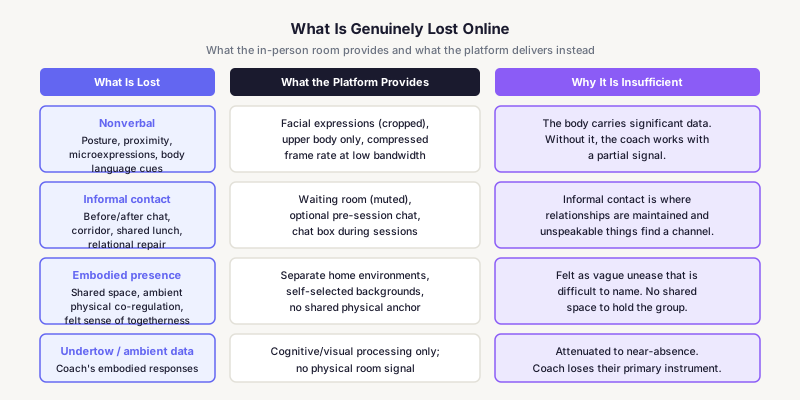
Nonverbal communication is only partially transmitted through video. Posture, proximity, the spontaneous microexpression, the way someone's body shifts when something important is said — these are available in person and absent online. The platform transmits the face. It does not transmit the body that the face is attached to, and the body carries significant data.
Informal contact disappears almost entirely. The five minutes before the meeting starts, the corridor conversation, the shared lunch, the aside that happens when two people are walking to the same place — these are not trivial social lubricant. They are where relationships are maintained, where information that cannot enter the formal session finds a channel, where the team learns what is actually happening with each other. The platform replaces them with a waiting room and a mute button.
Embodied presence — the felt sense of being in a room together — cannot be transmitted digitally. The shared space, the common air temperature, the background noise, the peripheral awareness of other bodies: these create a baseline of physical co-regulation that groups use without knowing they use it. Its absence is felt as a vague unease that is difficult to name.
Finally, what Thornton calls the undertow of the room — the ambient emotional data that coaches use to read what is happening beneath the surface — is largely unavailable online. The coach who works in person uses their own embodied responses as data: the slight constriction in their chest when the team avoids a topic, the subtle shift in energy when something real is said. These signals are attenuated online, sometimes to the point of absence.
Hybrid and blended coaching
Hybrid coaching describes an arrangement in which some sessions happen in person and some online — the same team, alternating between two modes over time. This is manageable. The in-person sessions do the relational work that the online sessions cannot do. The online sessions handle the content that does not require embodied presence. The two modes complement each other when the coach designs them to.
Blended sessions — in which some participants are in the room together and others are joining remotely — are the hardest configuration and the one most commonly underestimated. The in-room group forms a sub-group with nonverbal access to each other that the remote members are excluded from. Side glances, shared reactions, the slight lean toward one person or away from another — these are visible to everyone in the room and invisible to everyone on the call. The coach who is physically present also has privileged access: they are inside the in-room sub-group whether they intend to be or not. This creates an asymmetry that must be explicitly managed rather than assumed away. Without deliberate intervention, the blended session functions as a room session with a live-stream — not as a single group.
Why the platform amplifies anxiety rather than containing it
Silence in a video call reads as technical failure or social discomfort, not as thinking. The pause that would be perfectly natural in person — two or three seconds while someone finds the right words — triggers a reflex to fill the gap online. The silence has too many possible meanings, none of them good, and the group moves to eliminate it before finding out what it means.
Eye contact is technologically impossible. You look at the camera or at the person on the screen; you cannot do both. The result is that online interaction is conducted without the most fundamental signal of mutual attention and recognition. The video call is a conversation in which no one can make eye contact with anyone.
Spontaneous interaction is replaced by raised hands and turn-taking protocols. The conversation that emerges naturally from physical proximity — two people starting to respond to the same thing at the same time, finding their way through it together — becomes a traffic management problem. The holding conditions of the room — the shared space that the group occupies together — are absent, and the anxiety that the room would absorb has nowhere to go.
What coaches need to provide more of online
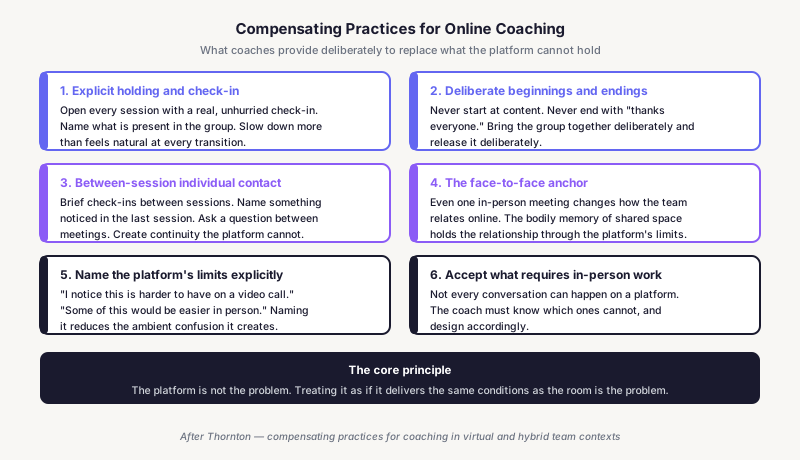
Explicit holding must replace implicit holding. In a physical room, the group is held by the space itself — by walls, by furniture arrangement, by the physical presence of the coach and the team. Online, the coach must provide this holding through deliberate structure: longer and more careful check-ins at the opening, explicit naming of what is present in the group at the start of each session, slowing down more than feels natural at every transition.
Beginnings and endings must be deliberate. The session should never begin at content — there needs to be a real opening, one that gives the group time to arrive rather than assuming arrival because the Zoom link has been joined. Closing must be equally explicit: a real ending, not a "thanks everyone" as people begin to drop off. The group needs to be brought together and released together, not allowed to assemble and dissolve informally the way it would in a hallway.
Individual contact between sessions becomes more important, not less. The brief check-in, the message that names something noticed in the last session, the question asked between meetings: these create continuity that the platform cannot provide. And the coach must accept that some things require in-person work. Not every conversation can happen on a platform. The question is knowing which ones cannot.
The single most important move
Even one in-person meeting anchors the subsequent online work. Teams that have met in person once — that have shared physical space, that have a bodily memory of each other — relate to each other online differently from teams that have never been in a room together. The face-to-face anchor is not a nice-to-have for high-stakes work. It is what makes the online relationship possible at depth.
The team that has met in person has a reference. When the video call is flat and the silence reads wrong, they can access the memory of how it felt to be in the room together. That memory does something. It holds the relationship through the limitations of the medium in a way that no technique can replicate.
Not less WiFi — different conditions
The platform is not the problem. The problem is treating the platform as if it delivers the same coaching conditions that the room delivers. It does not. The coach who runs the same session online that they ran in person has not adapted to a different medium — they have imported a set of assumptions that no longer hold. The team that is more compliant and less generative is not failing to engage. It is responding accurately to an environment that is genuinely harder to think in. The coach's job is to compensate for what is missing — to provide deliberately what the room provided automatically — not to pretend the difference isn't there.
Continue Exploring
Go deeper into the work
The Book
The Art of Creating Self-Organizing Teams
The full framework behind this article — contracting, team dynamics, and practical coaching tools for every stage of the journey.
Companion Toolkit
Resistance Radar & Resilience Scorecard
Practical tools for mapping resistance patterns and measuring whether interventions increased capacity — not just compliance.
TA for Agile
Co-creative TA in Agile Contexts
Ego states, psychological contracts, group imago, and the relational concepts that underpin this article — applied to real teams.