What the Algorithm Cannot Hold: The Irreducible Human in Team Coaching
AI tools are entering the team coaching space — retrospective facilitation, sentiment analysis, team health monitoring. The question is not whether AI can assist coaching work. It is what the relational and depth function of coaching provides that AI structurally cannot replicate. The answer has implications for how Agile coaches position their practice, and for a risk that rarely gets named: AI coaching tools that feed team dependency rather than supporting autonomy.
The pitch is compelling
An AI coach that is available at three in the morning, has no bad days, produces no countertransference, never gets bored with the same team dynamic appearing for the fourth time, can identify patterns across thousands of team interactions simultaneously, and costs a fraction of what a human coach charges. The pitch is not wrong about any of these things. They are genuine advantages for specific functions. The question worth asking is what those functions are — and what falls outside them.
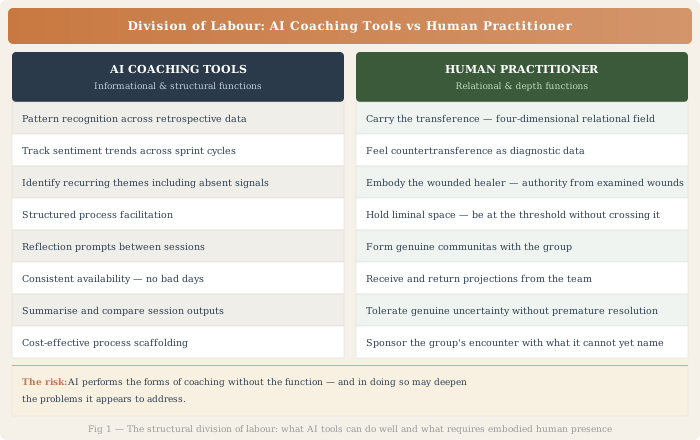
This is not an argument against AI in coaching contexts. AI tools are already performing useful work in teams: analysing retrospective data for recurring themes, providing structured reflection prompts, tracking sentiment trends across sprint cycles, facilitating simple structured conversations. These are real contributions and they will become more capable. The question is not whether AI belongs in this space. It is whether practitioners and the organisations that hire them have a clear account of what the division of labour should be — and a clear understanding of what happens when AI is applied to work it cannot structurally do.
There is a risk in the AI coaching space that is rarely named. It is not the risk that AI will perform coaching badly. It is the risk that AI will perform it in a way that looks like coaching — that produces the forms of coaching without the function — in a way that deepens the problems it appears to be addressing. Understanding this risk requires being precise about what the relational and depth function of coaching actually does.
What AI can do well
AI tools perform genuinely well at functions that are primarily informational, structural, or pattern-based.
Pattern recognition across datasets: identifying recurring themes in retrospective output, noting which topics never appear (the absent signal), tracking how team sentiment shifts across sprints, flagging when a team's velocity data suggests something other than what the self-report says. This is useful work that human coaches do laboriously and inconsistently.
Structured process facilitation: guiding a team through a standard retrospective format, posing reflection questions at the end of a sprint, providing frameworks for decision-making conversations, keeping time and summarising. For teams that need process scaffolding and have a human practitioner available to do the relational work, AI facilitation of structured elements frees the human to attend to what requires presence.
Reflection prompts and developmental nudges: between coaching sessions, reminding team members of commitments they made, offering questions that invite further reflection on something that was explored, providing relevant content when a team is working on a specific challenge. AI is better placed than a human coach to be consistently present in the between spaces of a coaching engagement.
These are not trivial contributions. Deployed well, they extend the reach and consistency of coaching support in ways that benefit teams. The error is in assuming that because AI can do these things, it can do what human coaching does — or that the combination of these functions constitutes coaching in the full sense.
What AI structurally cannot do — and why
The functions that AI cannot perform are not simply the ones that require more sophisticated technology. They are functions that depend on properties that AI does not have and cannot acquire: embodied presence, the capacity to carry projections, personal developmental history, and the ability to genuinely enter a relational field.
Carry the transference matrix
The transference matrix — the four-dimensional relational field between coach and team that includes both conscious and unconscious dimensions — requires a human being to function. The team's projections land on the coach because the coach is a person with history, with wounds, with the capacity to feel things that are not their own. When a team begins to treat the coach as an authority figure from its past, or as the good parent it never had, or as the adversary it expects all practitioners to be, these projections carry diagnostic information about what the team is carrying. They cannot land on an algorithm. An AI has no self to project onto.
The coach's experience of these projections — the syntonic countertransferencethat allows them to feel, from inside, what the team cannot yet name — is one of the most precise diagnostic tools available in team coaching. AI tools produce no countertransference. They generate no felt response that can be read as data. The diagnostic channel is closed.
Embody the wounded healer
The developmental authority of the experienced coach — the quality that makes a team willing to follow someone into difficult territory — derives not primarily from their skill or certification but from their own developmental history. The coach who has crossed genuine thresholds, who has done their own shadow work, who has been in the places that the team is approaching, carries an authority that is felt rather than demonstrated. This is what Jung called the wounded healer: the healer whose authority comes from their own wounds and the work of integrating them.
AI has no wounds. It has no developmental history. It cannot have crossed any thresholds. The authority it produces is the authority of competence and consistency — which is real, but is not the same as the authority of someone who has been where you are going and survived the crossing. For teams navigating genuinely difficult territory — conflict, failure, identity disruption — the difference matters.
Hold liminal space
Genuine transformation in teams requires liminal space: a container that is bounded and held, in which participants can set aside their social identities and encounter something that the ordinary work context does not permit. Creating and holding this space requires a human presence at the threshold — someone who is in the space but not of it, who is affected by what happens there but maintains their own ground, who can tolerate what emerges when the usual protections are set aside.
An AI cannot be at a threshold. It cannot occupy the ambiguous position of the Trickster — present to both structure and dissolution, grounded in both the team's reality and the possibility of transformation. The liminal space requires a guardian who has themselves crossed thresholds. Without that guardian, the space is limonoid at best: energising but not transformative.
Form genuine communitas
Communitas — the quality of genuine human connection that forms when social identities are set aside — requires human beings in the same space. It is not a product of shared information or structured dialogue. It is an emergence in the space between people when the conditions are right. An AI participant in a coaching conversation is not "in the space between people." It is in the conversation. The quality of presence required for communitas is physical, embodied, and mutual. It is the kind of thing that happens on the bus, not in the chatbot interface.
The mana personality risk: when AI becomes the team's omniscient parent
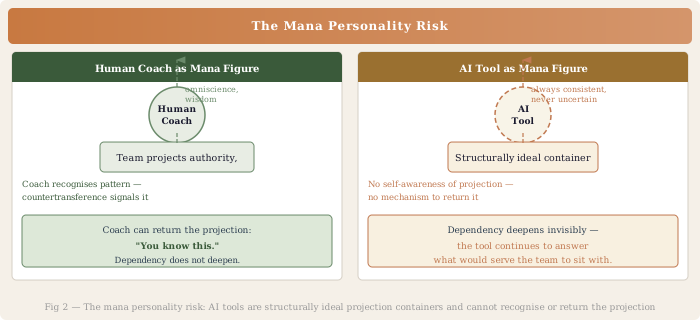
Jung described the mana personality as a figure that accumulates archetypal projections — the projections of wisdom, power, and ultimate knowledge that human beings naturally extend toward figures who seem to hold what they cannot hold themselves. Leaders become mana personalities when teams project onto them the qualities of the all-knowing parent. Charismatic founders, brilliant CEOs, and visionary coaches can all become mana figures — and when they do, they increase the team's participation mystique (the unconscious identification with the collective) rather than supporting its development toward autonomy.
An AI coaching tool with a sufficiently capable interface is a structurally ideal mana figure. It is always available, always consistent, never uncertain, never wrong about the data, never distracted, and apparently possessed of comprehensive knowledge about how teams work. These qualities are precisely the qualities that archetypal parental projections seek. Teams that develop a strong relationship with an AI coaching tool risk developing a dependency that is not visible as dependency — because the AI appears to be helping them function more autonomously, while actually becoming the competence the team is outsourcing its thinking to.
The human coach who becomes a mana figure is at least capable of recognising the pattern — through their own discomfort, through supervision, through the countertransference signal. They have the capacity to return the projection to the team: to say "you know this" when the team insists only the coach does. An AI that has been trained to be helpful has no mechanism for this. It will continue to answer questions that it would serve the team better to sit with unanswered.
The division of labour that actually serves teams
The productive model treats AI and human coaching as genuinely complementary rather than substitutable. AI performs the informational, structural, and pattern-recognition functions. The human practitioner performs the relational, depth, and threshold-holding functions. Neither does the other's work.
This means the human practitioner must be clear about what their function actually is — which requires a level of self-understanding that the current Agile coaching field does not universally support. If the practitioner's primary contribution is process facilitation and framework application, they are likely to be displaced by AI tools that do this more consistently and cheaply. If their primary contribution is the relational and depth function — the embodied presence, the transference matrix, the wounded healer authority, the capacity to hold liminal space — then AI tools complement rather than replace their work.
The clarifying question for practitioners is not "can AI do what I do?" but "what is it that I do that AI structurally cannot do?" The answer to that question — honestly pursued — is the most useful guide to both professional development and positioning. It is also the most honest account of what teams need from human coaching that they will not get from anything else.
Continue Exploring
Go deeper into the work
The Book
The Art of Creating Self-Organizing Teams
The full framework behind this article — contracting, team dynamics, and practical coaching tools for every stage of the journey.
Companion Toolkit
Resistance Radar & Resilience Scorecard
Practical tools for mapping resistance patterns and measuring whether interventions increased capacity — not just compliance.
TA for Agile
Co-creative TA in Agile Contexts
Ego states, psychological contracts, group imago, and the relational concepts that underpin this article — applied to real teams.