What the Product Owner Is Actually Carrying
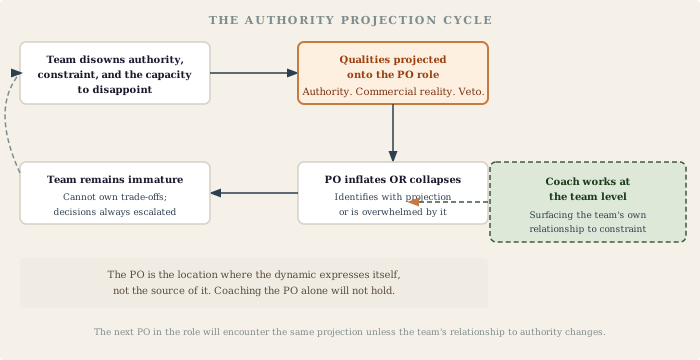
Product Owner problems — the unilateral, the conflict-avoidant, the impossible — are almost always team projection problems. The PO role is structurally positioned to receive the team's disowned relationship to authority, commercial reality, and the capacity to disappoint. The result is a PO who inflates or collapses, and a team that never develops a mature relationship to constraint. Coaching the PO in isolation will not hold.
The PO that nobody can work with
The complaint arrives before the coaching engagement properly begins: "our Product Owner is the problem." In some versions the PO is described as impossible — unilateral, dismissive of team input, increasingly certain in an environment that calls for collaboration. In others, the problem is the opposite: a PO who cannot say no, who consults endlessly and decides nothing, who frames every priority as "it depends" and leaves the team with a backlog that reflects no one's actual judgement.
The coach who takes these complaints at face value and begins by working with the Product Owner — on communication style, stakeholder management, prioritisation technique — is addressing the wrong level. Not because the PO has no role in the dynamic, but because the PO role is the location where a team-level process is expressing itself. The problem is not the Product Owner. It is what the team has placed in the Product Owner.
Product Owner problems — the full spectrum from the tyrannical to the absent — are almost always, at root, team projection problems. Understanding the mechanism explains why PO coaching so often fails to hold, why the same patterns recur across different individuals in the role, and what the coach needs to be working on instead.
What projection is — and how authority projection differs from shadow election
Projection is the psychic mechanism by which qualities that belong to the self — or to the group — are experienced as belonging to another. The qualities projected are typically those that cannot be consciously owned: in shadow election, the team's disowned failure, inadequacy, or aggression is located in an individual who then carries it for the group. The elected carrier holds the shadow.
Authority projection operates on different material. What is projected onto the PO role is not the shadow — not what the team is ashamed of or cannot acknowledge. It is something more fundamental: the team's own capacity to make decisions, to say no, to hold the line against demand, to disappoint stakeholders, and to take responsibility for the consequences of choosing between incompatible goods. These are capacities that the team formally possesses but cannot fully inhabit — because inhabiting them is uncomfortable and because the PO role offers a structural location for disowning them.
The PO role is the most authority-saturated position in a Scrum team. It owns the backlog. It sets priorities. It says yes or no to what gets built. These are functions that teams find it difficult to hold collectively — not because they lack capability but because collective authority requires collective accountability, which is harder to sustain than delegating both to a single role.
Melanie Klein's concept of splitting helps clarify the mechanism. In early development, the psyche deals with ambivalence — the uncomfortable coexistence of love and frustration toward the same object — by splitting: the object becomes either wholly good or wholly bad, and the psyche engages with each pole separately. Teams dealing with the ambivalence of authority — its necessity and its burdensomeness — do something similar: they project the authority function onto the PO and then engage with it there, in a form that is cleaner and more manageable than owning it collectively.
The three qualities the team locates in the PO
The capacity to disappoint. Delivery teams exist in a context of competing demands. Stakeholders want more than the team can build. Business needs conflict with technical needs. Saying yes to one thing means saying no to another. The capacity to make these calls — to genuinely disappoint some of the people who are asking — is the core of prioritisation. Teams find this capacity difficult to inhabit collectively. It is easier and psychologically safer to locate it in the PO, whose role formally requires it, and then to engage with its exercise from a position of relative non-accountability.
Commercial reality. Teams are often more comfortable with the technical and craft dimensions of their work than with the commercial context that gives the work its meaning and its constraints. The relationship between what is being built and whether it generates value — and the uncomfortable realities of that relationship, including the possibility that the team's best work is commercially irrelevant — is material the team finds difficult to carry. The PO becomes the container for commercial reality: the one who speaks the uncomfortable language of value, viability, and market.
The authority to stop. The authority to say "that's enough — we're shipping this" is uncomfortable in teams that have built their identity around quality and craft. The PO who exercises this authority becomes, for the team, the force that overrides their standards. This is not always incorrect — some POs do override standards inappropriately. But the intensity of the team's response to the PO's prioritisation decisions — the sense of violation that accompanies what may be, from a business perspective, a legitimate call — often signals that the PO is carrying more than the specific decision. They are carrying the team's relationship to authority over their own work.
Inflation and collapse: the two failure modes
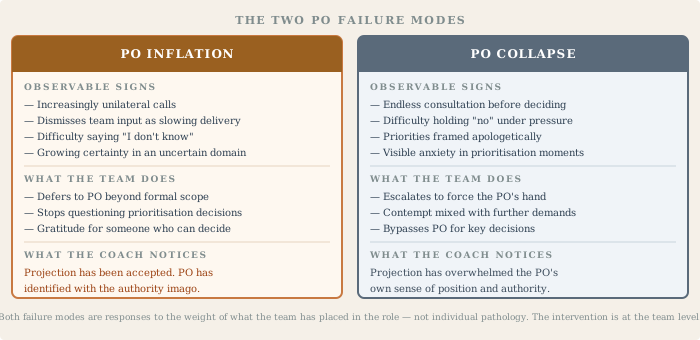
When a person holds a role that has become a container for a group's projected authority, two characteristic failure modes emerge. Both are responses to the weight of what has been placed there — but opposite responses, driven by different character structures.
Inflation occurs when the PO identifies with the projected authority — when they take in the team's projection and begin to inhabit it as their own. The inflated PO becomes increasingly certain, increasingly unilateral, increasingly resistant to the team's input. They are not exhibiting poor collaboration skills. They have been handed the authority imago — the archetypal image of the decision-maker who knows — and have identified with it. The team's gratitude for clear direction, its relief at having someone who can decide, reinforces the inflation. The PO has become what the team needed them to be, and the role has expanded to fill the projection.
Collapse occurs when the weight of the projected authority overwhelms the PO's own sense of position. The collapsed PO consults endlessly, defers to the team on decisions that are formally theirs, frames everything as provisional, and cannot hold the line in the face of disagreement. This is not indecisiveness — or not primarily. It is the response of someone who has registered the projective weight and found it intolerable. The team's demands on the PO — which are amplified by projection beyond what the role formally requires — have produced a paralysis that the team then reads as incompetence or weakness.
Menzies Lyth, studying defensive structures in institutions, described this dynamic as splitting — the institution's anxiety about responsibility is managed by concentrating it in a particular role, which then either carries it through rigidity or deflects it through diffusion. The PO role, in many teams, is precisely this kind of institutional defence.
Working with the team's relationship to constraint
The intervention that addresses the structural dynamic works at the team level, not at the PO level. The coach's target is the team's relationship to constraint, authority, and the capacity to disappoint — the material that has been projected onto the PO and needs to be recovered.
This work begins with making the team's disowned relationship to priority explicit. Not by naming the projection — "you have put your authority onto the PO" — but by creating situations in which the team has to exercise the disowned capacities directly. What do you think should be prioritised? Not what do you think the PO should prioritise — what do you actually think? If you had to make the call, what would you cut?
These questions are often experienced as uncomfortable. The team may initially resist them on the grounds that prioritisation is the PO's job. That resistance is itself diagnostic: it signals the degree to which the authority function has been relocated rather than owned. Sitting with the discomfort — not resolving it but naming it as information — begins the process of the team recovering what it has projected.
Klein's depressive position describes the developmental achievement of tolerating ambivalence: the capacity to hold love and frustration toward the same object simultaneously, without splitting. For a team, the equivalent is the capacity to own the trade-offs of prioritisation — to acknowledge that every yes is a no to something else, that the team's choices have consequences, and that this is not the PO's burden but the team's reality. The coach's work is to support the team's development toward this position.
What the PO needs from the coach — and what the coach cannot provide
The Product Owner caught in a projective dynamic — whether inflated or collapsed — does need coaching support. But the support they need is not primarily behavioural. It is help in understanding what they are carrying and how to relate to it without being absorbed by it or overwhelmed by it.
The inflated PO needs help recognising when their certainty is the team's projection rather than their own assessment — when they are speaking with a conviction that doesn't belong to them. This is subtle work: the inflation feels like clarity, and the PO who is in it experiences their certainty as appropriate confidence. The coach who can point to specific moments where the certainty exceeds the evidence, without attacking the PO's competence, is offering something valuable.
The collapsed PO needs help holding their own ground against the projective pressure — recognising that the team's endless consultation is not primarily a request for input but a disowning of the authority function, and that they do not have to accept the weight of that disowning. The structural move is the same as for the inflated PO: disentangling what belongs to the PO's actual role from what the team has placed there.
What the coach cannot provide — and what PO coaching without team-level work will fail to produce — is a sustainable change in the PO's functioning while the projective dynamic remains in place. The next PO in the role will encounter the same projection. The current PO will oscillate between inflation and collapse in response to the same pressures. The container has not changed. Until the team's relationship to its own authority changes, the Product Owner role will continue to be both the most powerful and the most difficult position in the team — not because of who occupies it, but because of what the team has placed there.
Continue Exploring
Go deeper into the work
The Book
The Art of Creating Self-Organizing Teams
The full framework behind this article — contracting, team dynamics, and practical coaching tools for every stage of the journey.
Companion Toolkit
Resistance Radar & Resilience Scorecard
Practical tools for mapping resistance patterns and measuring whether interventions increased capacity — not just compliance.
TA for Agile
Co-creative TA in Agile Contexts
Ego states, psychological contracts, group imago, and the relational concepts that underpin this article — applied to real teams.