When Agile Becomes Its Own Opposite
Teams that have pursued Agile values with consistent commitment often produce, through the unimpeded expression of those values, the exact pathologies the values were designed to prevent. Radical transparency becomes performative. Psychological safety produces passive agreement. Autonomy generates covert hierarchy. Jung's concept of enantiodromia — the law of opposites — explains the mechanism and points toward a different kind of work.
The team that got everything it asked for
The team had been asking for two years. More autonomy. Less micromanagement. The freedom to decide how they worked without having every proposal reviewed, questioned, and quietly redirected by leadership. They were good at what they did. They knew it. They wanted to be trusted to act on that knowledge.
The organisation gave it to them. New structure, new charter, genuine authority over their own process. The coach came in six months later to find something unexpected: a team with more process rigidity than they had had under the old management, a more elaborate hierarchy of informal power, and a culture of retrospective performance — careful, diplomatic, devoid of anything that might disturb the surface.
The team had not failed to be autonomous. They had been autonomous — and had produced, through the unimpeded expression of their own values, the thing those values were designed to prevent. The autonomy had become its own opposite.
Jung called this enantiodromia. It is one of the most consistent and least-discussed dynamics in organisational coaching, and understanding it reframes a category of team failure that standard coaching approaches cannot account for.
What enantiodromia means — and why Heraclitus had it first
The term comes from Heraclitus, who observed that everything flows into its opposite: hot becomes cold, day becomes night, war gives way to peace and peace to war. The underlying principle is the interdependence of opposites — that any quality carries its opposite within it, and that the more completely one pole is expressed, the more inevitably its suppressed counterpart will eventually assert itself.
Jung extended this into a psychological principle: whenever a one-sided attitude dominates the psyche — individual or collective — it builds pressure in its suppressed opposite until that opposite erupts, often suddenly and in a form that seems to contradict everything the dominant attitude stood for. The phenomenon he was describing was not inconsistency or failure. It was a structural consequence of one-sided development.
What makes enantiodromia different from simple overcorrection or balance failure is the mechanism: the reversal does not come from outside, as a correction to an error. It comes from within the same value system, through the extremity of the value's own expression. The autonomy-seeking team does not become hierarchical because it is forced to. It becomes hierarchical because the unmediated expression of autonomy — without integration of its opposite — generates the thing it was fleeing.
This is the mark of enantiodromia rather than simple failure: the reversal is produced by the same mechanism that generated the value. The team that values psychological safety so highly that disagreement becomes unspeakable has produced safety's opposite — suppression — through the instrument of safety itself.
Five Agile values and the shadows they generate
Agile's core values are not arbitrary. They were responses to real problems: excessive documentation, rigid hierarchy, processes that protected the organisation's structure rather than serving the work. The values were corrective — and like all corrective movements, they carried the risk of their own excess.
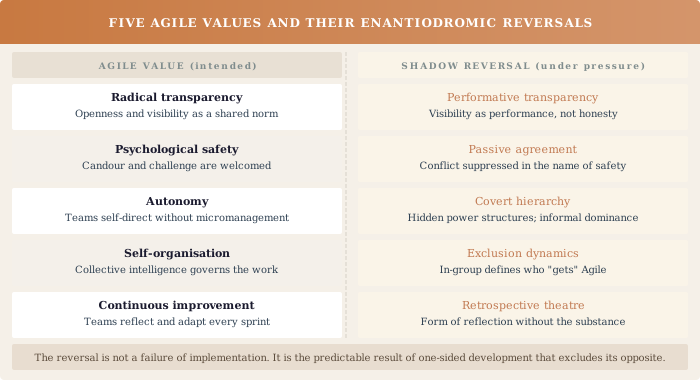
Radical transparency becomes performative transparency: the ritual of visibility without the substance of honesty. Teams that have absorbed the value of openness completely often develop sophisticated cultures of impression management that are more elaborate and less accessible than the opacity they replaced. The board is updated. The metrics are shared. Nothing important is said in the retrospective. The ceremony of transparency is performed with precision while the actual state of the work — the conflicts, the real assessment of the product, what the team privately thinks of the leadership's decisions — lives in the corridor.
Psychological safety becomes passive agreement: the suppression of conflict disguised as the creation of safety. The team that has worked hard to establish a safe environment — where challenge is valued, candour encouraged, mistakes treated as learning — may find, after some years, that it has produced an environment where disagreement is uncomfortable precisely because everyone is supposed to be safe. The expectation of safety becomes the reason challenge cannot be risked. The norm of openness becomes the norm that closes down genuine difference.
Autonomy becomes covert hierarchy: self-organisation with hidden power structures. The removal of formal authority does not remove the need for authority. It relocates it into the informal domain — into influence networks that are less visible, less accountable, and often more rigid than the formal structures they replaced. The team that organises itself creates its own hierarchy. The difference is that this hierarchy cannot be named, challenged, or negotiated in the way formal authority can, because to name it would be to admit that self-organisation has not been achieved.
Self-organisation becomes exclusion dynamics: informal in-group definition. The team that has built its identity around a shared understanding of "what good looks like" and "how we work here" develops, through the very coherence of that identity, a mechanism for excluding those who do not share it. The values of Agile become tribal markers. The team's self-organisation becomes the basis for deciding who "gets it" and who does not, who is a real contributor and who is outside the circle. The principle of collective intelligence generates a structure that suppresses it.
Continuous improvement becomes retrospective theatre: the form of reflection without its substance. The retrospective is a ceremony of improvement — and like all ceremonies, it can be performed without the thing it is supposed to produce. The team that has internalised the importance of reflection holds the retrospective with precision. The sticky notes accumulate. The action items are generated. The session is productive. What does not happen is the engagement with what actually needs to change, which requires a willingness to sit with genuine discomfort that the polished retrospective ceremony cannot accommodate.
Why moderation is not the answer
The standard response to the observation that Agile values generate shadow reversals is to recommend balance: don't be too autonomous, don't be too transparent, don't pursue self-organisation at the expense of structure. This is not wrong, but it misses what enantiodromia is actually pointing toward.
Moderation applied from outside — as a corrective prescription — does not integrate the opposite. It suppresses the dominant value without engaging with what that value was trying to do, and without genuinely incorporating what it was excluding. A team that has been told to be "less autonomous" has not developed a mature relationship with constraint. It has had a restriction imposed. The underlying tension between autonomy and authority is not resolved. It is managed — which is not the same thing.
What enantiodromia requires is not moderation but integration: a genuine encounter with the disowned pole that allows the team to consciously hold both positions simultaneously. The team that has experienced the shadow of radical transparency — the performative quality that openness produces when it is not grounded — and has worked with that experience, is in a fundamentally different position from the team that has simply been cautioned about over-sharing. It has discovered something about transparency from inside the experience of its failure. That discovery cannot be prescribed.
Von Franz, working with enantiodromia in the context of individual psychological development, described integration as "making the enemy a citizen" — not destroying the opposite or suppressing it, but finding the conditions under which it becomes a productive part of the whole. For a team experiencing the shadow of psychological safety, the question is not how to reduce the emphasis on safety but how to make the discomfort of genuine disagreement a valued part of what safety produces. The opposite is not the enemy of the value. It is what the value needs to remain alive.
The coach's task: holding the shadow without collapsing it
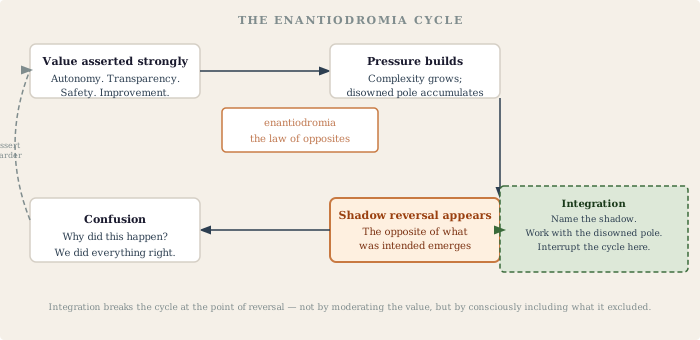
The coach working with enantiodromia faces a specific problem: the team that is experiencing the shadow reversal of one of its values is not experiencing it as a shadow reversal. It is experiencing it as evidence that it has not yet succeeded at the value. The team whose psychological safety has produced passive agreement believes it needs more safety. The team whose transparency has become performative believes it needs better formats for honesty. The diagnosis is reversed: the cure is more of the same thing that produced the problem.
This is why the coach cannot simply name the pattern. To name it directly — "your pursuit of safety has produced its opposite" — is to attack a value that the team holds as constitutive of its identity. The response is almost always defensive, sometimes hostile. The team experiences the observation as a criticism of something it has worked hard to build, rather than as a structural observation about what that work has produced.
The coach's task is to hold the shadow visible without collapsing it prematurely into diagnosis. This means staying in contact with the discomfort the team is experiencing at the surface — the sense that something isn't working despite doing everything right — while resisting the pull to resolve it quickly. The resolution of enantiodromia comes through the team's own encounter with the reversal, not through the coach's interpretation of it.
The practical work is often question-based: helping the team attend to the gap between its stated values and its actual experience, without naming the gap as failure. What do you notice about how the retrospective goes? What is the difference between what you say about disagreement and how you experience it in practice? What would it look like if the opposite were also valued here? These questions open territory without forcing a conclusion. They allow the team to discover the reversal as its own observation rather than receiving it as an external verdict.
When to name it — and when not to
There are moments when naming the pattern directly is the right move. These are moments when the team has itself arrived at the edge of the observation — when someone has said something that carries the recognition without completing it, when the group's energy signals that the ground has shifted and something can now be said that could not have been said before.
At these moments, the coach's naming is a completion rather than an imposition. It gives language to something the team has already partially seen. The risk of saying it too early is that the team experiences the observation as the coach's conclusion rather than its own discovery — and defends against it accordingly. The risk of saying it too late is that the team remains in the confusion of the reversal without a frame that would allow it to act.
The frame, when it is offered, does not need to be Jungian. Enantiodromia as a word is unnecessary. What matters is the structural observation: that this pattern — the value producing its own opposite — is not a failure of the team's competence or commitment. It is a predictable consequence of one-sided development. This distinction matters because it changes the team's relationship to the problem. A failure of competence requires improvement. A structural consequence of one-sided development requires integration — a different kind of work that begins with acknowledging what has been excluded rather than trying harder at what is already being done.
The team that got everything it asked for, and produced through that achievement the thing it was trying to escape, is not a team that failed. It is a team that succeeded at one pole and discovered, in that success, what it had left out. The coach who can hold that observation — and who can resist the pull to fix it before the team has fully encountered it — is doing the specific work that enantiodromia requires.
Continue Exploring
Go deeper into the work
The Book
The Art of Creating Self-Organizing Teams
The full framework behind this article — contracting, team dynamics, and practical coaching tools for every stage of the journey.
Companion Toolkit
Resistance Radar & Resilience Scorecard
Practical tools for mapping resistance patterns and measuring whether interventions increased capacity — not just compliance.
TA for Agile
Co-creative TA in Agile Contexts
Ego states, psychological contracts, group imago, and the relational concepts that underpin this article — applied to real teams.