When Culture Is the Client: Coaching Agile in High Power Distance Teams
Agile frameworks were designed in a specific cultural context — individualist, low power distance, with a premium on explicit communication. When deployed in high power distance cultures, the framing of 'make impediments visible,' 'challenge the process,' and 'psychological safety' arrives as a set of culturally alien demands. The coach who imports methods without adapting them will find that teams perform safety rather than experiencing it — a different version of the same theatre.
The retrospective that doesn't work the way it's supposed to
The facilitator has done everything right. The questions are open. The format is safe — sticky notes, not speaking in turn, themes emerging from the data rather than named by any individual. The room is quiet. The sticky notes accumulate. There are many sticky notes about process and very few about anything that actually generated them. The facilitator reads the room and understands that something is being held back, but the tools available — asking open questions, naming the silence, inviting people to speak — do not reach it. The conversation ends at the surface. The team leaves looking slightly relieved.
This is a team in Singapore, in an organisation with predominantly Singaporean and Malaysian members. The facilitator is European. The format was designed for a low power distance, individualist, explicit-communication context. Deployed here, it has produced a technically correct performance of a retrospective — and no access to what the team is actually experiencing.
This is not a facilitation failure. It is a cultural mismatch at a structural level. The tools that make psychological safety accessible in one cultural context can actively obstruct it in another — not because the people in the room are resistant, but because the tools carry cultural assumptions that conflict with how the people in the room understand legitimate behaviour, appropriate authority, and safe communication.
The cultural assumptions baked into the Agile manifesto
Agile frameworks were written in 2001 in Snowbird, Utah, by seventeen people who were predominantly white, American, and male, working in software engineering in a country with one of the lowest power distance scores in Hofstede's cultural dimension research. The manifesto values they articulated — individuals and interactions, responding to change, customer collaboration — are not culturally neutral. They embody a specific cultural psychology: individualist, egalitarian, direct, empirical, and suspicious of formal authority.
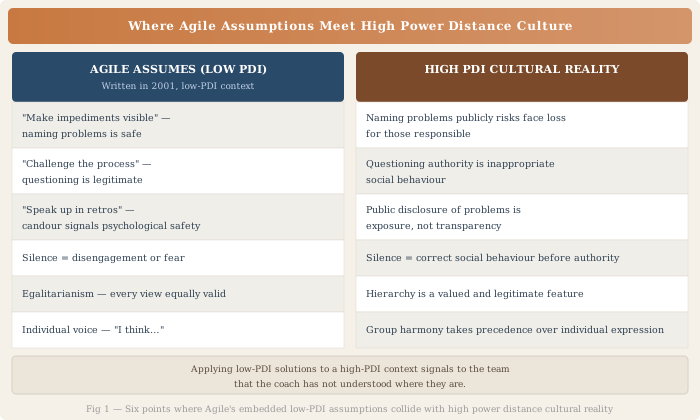
The practices derived from this manifesto carry the same assumptions. "Make impediments visible" assumes that impediments can safely be named, which assumes that naming them does not expose the speaker to loss of face or retribution from those responsible. "Challenge the process" assumes that challenging is legitimate, which assumes that authority is appropriately questioned rather than appropriately respected. "Speak up in retros" assumes that speaking up is safe, which assumes a relationship between candour and belonging that is culturally specific.
In high power distance cultures — which include most of East and Southeast Asia, South Asia, the Arab world, Latin America, and much of Africa — these assumptions do not hold. Power distance, in Hofstede's definition, is the degree to which less powerful members of a society accept and expect unequal distribution of power. In high PDI cultures, hierarchy is not a regrettable organisational necessity. It is a legitimate and valued feature of social life. Respecting authority is not compliance. It is appropriate social behaviour.
What high power distance actually means for team dynamics
High PDI is not simply "they don't speak up." That description is already a low-PDI frame: it treats silence as a failure to do something that would be natural if only the environment were safer. In a high PDI context, silence in the presence of authority is often the correct social behaviour — not because the person is afraid, but because speaking before invited to do so, or publicly disagreeing with someone of higher status, violates the social contract that makes the group work.
The Joseph Henderson concept of the cultural unconscious — the layer of shared historical memory and image that lies between the collective unconscious and the manifest patterns of a particular culture — helps explain why this is not simply a preference that training can overcome. The cultural complex around authority in a Confucian-influenced society, for example, has been formed over centuries of shared history, reinforced by family structure, educational institutions, religious practice, and economic organisation. It is not a surface attitude. It is a deep structure of how the psyche organises its relationship to the social world.
The cultural complex around face — the social currency of reputation, dignity, and standing — adds a further dimension. In face-maintaining cultures, the public disclosure of problems, errors, or interpersonal conflicts is experienced not as transparency but as exposure. The retrospective format that asks people to name what went wrong in front of their peers and their manager is, in this context, an invitation to lose face — not to build safety. The silence is not fear of punishment. It is self-protection within a legitimate social framework.
What coaches typically do that makes it worse
The most common error is to treat the cultural context as an obstacle to overcome rather than as the actual system to work with. The coach who responds to silence by increasing the psychological safety interventions — more anonymous formats, more explicit invitations, more declarations that "this is a safe space" — is applying a low-PDI solution to a high-PDI context. The signal the team receives is that the coach has not understood where they are.
A second error is the assumption that the team's high-PDI cultural complex is simply a deficit — something to be educated out of, developed through, or overcome on the way to a more "mature" Agile culture. This assumption is itself a cultural complex: the conviction that low-PDI, individualist, explicit-communication cultures represent a developmental endpoint that other cultures are progressing toward. It is not only wrong; it is an active obstacle to working effectively in the context.
A third error is coaching the culture while ignoring the shadow of the dominant approach. Agile's low-PDI assumptions carry their own shadow: the suppression of contextual wisdom, the dismissal of formal expertise, the misreading of appropriate deference as incompetence or fear. The coach who cannot see this shadow will persistently misread the cultural signals they are receiving.
Methods that travel: symbol, story, oblique inquiry
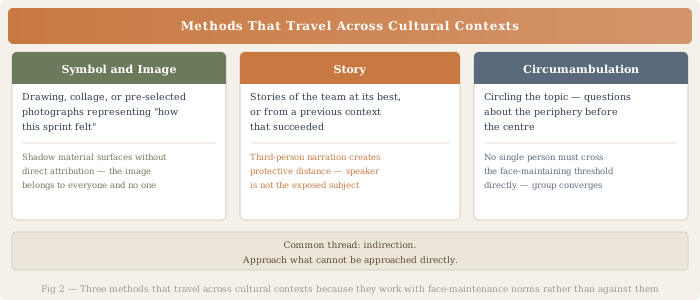
The methods that travel across cultural contexts share a characteristic: they work indirectly. They approach what cannot be approached directly through the use of symbol, story, image, or structured indirection — allowing content to surface without requiring anyone to "own" it publicly in a way that violates the face-maintenance norms of the context.
Symbol and image. Asking a team to represent "how this sprint felt" through a drawing, a collage, or an image from a pre-selected set of photographs creates a layer of abstraction that allows shadow material to surface without the direct attribution that direct verbal expression would require. The image belongs to everyone and to no one. It can be examined without identifying the person who felt what it represents.
Story. Inviting team members to tell a story — of a time the team worked at its best, of a project in a previous organisation that succeeded for reasons they could articulate — creates the same protective distance. Story is third-person. It does not require the speaker to be the subject of the account in a way that exposes them. And stories, in the Jungian tradition, carry the same diagnostic richness as images: what people choose to tell, and how they tell it, reveals what they cannot say directly.
Circumambulation. Barrett's term for approaching what cannot be approached directly by circling around it — asking questions about the periphery of a topic before asking about its centre. In a high-PDI context where direct question about a problem will produce silence or deflection, circling questions can bring the team gradually closer to the material without requiring any single person to cross the face-maintaining threshold directly.
Adapting the coach's own posture
Working effectively in high PDI contexts requires more than methodological adaptation. It requires the coach to examine their own cultural complex: the assumptions about candour, egalitarianism, and appropriate authority that they carry from their own cultural formation and treat as universal.
A coach from a low-PDI background working in a high-PDI context will experience a persistent pull toward "getting people to speak up" — toward treating the silence as a problem to be solved rather than a communication in its own right. The silence in a high-PDI team is not nothing. It is a form of social organisation. The coach who can learn to read silence rather than treat it as absence will find that teams communicate through it with considerable precision.
The posture that works is one of genuine curiosity about the cultural system rather than expert confidence about the right way to do Agile. The coach who arrives with the assumption that their framework is universal, and the culture is the variable to be adjusted, has it backwards. The culture is the ground. The framework is the variable. Effective coaching in cross-cultural contexts requires the coach to be genuinely willing to adapt their methods to preserve their purpose — which is the development of the team's capacity to work together well, whatever form that takes in this particular context.
The retrospective in Singapore that produced only process-level sticky notes was not a failed retrospective. It was a retrospective designed for a different context, producing the correct output for that context: technically safe engagement, surface-level information, and the preservation of the social fabric. The coach's task was not to break through this but to find a different entry point — one that worked with the cultural complex rather than against it, and that created space for the team to share what it actually needed to share through a route it could actually take.
Continue Exploring
Go deeper into the work
The Book
The Art of Creating Self-Organizing Teams
The full framework behind this article — contracting, team dynamics, and practical coaching tools for every stage of the journey.
Companion Toolkit
Resistance Radar & Resilience Scorecard
Practical tools for mapping resistance patterns and measuring whether interventions increased capacity — not just compliance.
TA for Agile
Co-creative TA in Agile Contexts
Ego states, psychological contracts, group imago, and the relational concepts that underpin this article — applied to real teams.