When the Ceremony Dies: How Agile Rituals Lose Their Power and How to Restore It
Nobody decided to kill the retrospective. It just stopped mattering. A ceremony that once had genuine energy — where things were said and decisions made — becomes a scheduled slot that everyone endures. The problem is usually diagnosed as bad facilitation and addressed with better formats. These help briefly, then the decay resumes. The real issue is liminal: the ceremony has lost its threshold quality. Restoration requires redesigning the boundary, not the agenda.
Nobody decided to kill it
Nobody made a decision to kill the retrospective. It just stopped mattering.
The team still holds it. Attendance is good. The facilitator is competent. The format rotates — sometimes it's the sailboat, sometimes the four Ls, sometimes a simple open discussion. Action items are generated. A few get done. In the ceremony itself there is a quality of going through the motions that everyone feels and no one names. The coach watches it and knows that something has been lost, but the observable elements are all correct. What is missing is not a practice. It is a quality.
The standard diagnosis is facilitation failure: the format is stale, the questions are predictable, the facilitator lacks energy. The standard prescription is a better format, a different structure, an external facilitator to bring fresh perspective. These interventions sometimes produce a temporary restoration. The ceremony returns briefly to life, then decays again to the same level. The problem is not the format. The problem is that the ceremony has lost its threshold quality.
What makes a ceremony liminal
Victor Turner's concept of liminality applies to recurring ceremonies as much as to rites of passage. A ceremony is liminal when it creates a genuine threshold — when entering it requires participants to set something aside, to cross from ordinary work-state into a different quality of attention, and to be genuinely uncertain about what will emerge. The ceremony marks a boundary between the time before it and the time after it. It produces something that could not have been produced without it.
In its early life, many Agile ceremonies have this quality. The first retrospectives a team holds are genuinely uncertain: things get said that haven't been said before, decisions are made that change something, the experience of having spoken and been heard produces a quality that carries beyond the ceremony. The ceremony has threshold energy. People arrive slightly different from how they leave.
The alchemical image is the temenos — the sealed vessel that holds the energy of transformation. The ceremony, in its liminal state, is a temenos: a bounded space set apart from ordinary time and governed by different rules, in which something can be held and worked with that cannot be held in the ordinary flow of work. The boundary of the ceremony is not the meeting invite. It is the implicit understanding that different things are possible here.
How ceremonies calcify: the mechanics of decay
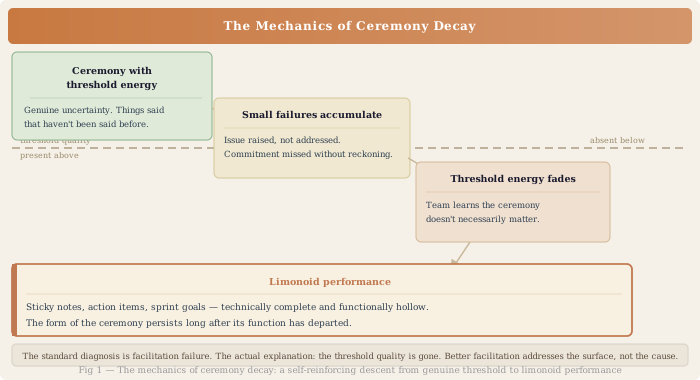
Decay is not sudden. It is gradual and self-reinforcing. It begins when the ceremony first fails to produce something it was expected to produce — when an issue raised in the retrospective is not addressed, when a planning commitment is missed without reckoning, when a standup discussion produces no decision. These failures are small. The team absorbs them and continues.
Over time, the accumulation of these small failures teaches the team something about the ceremony: that what happens inside it does not necessarily matter beyond it. The ceremony is no longer a threshold — it is no longer a space where something can be said that will change the work. It is a scheduled event with its own internal logic, largely disconnected from the work it is supposed to serve.
When the threshold energy is gone, a different dynamic takes over: the team performs the ceremony. They produce the outputs it expects — the sticky notes, the action items, the sprint goal — without genuine engagement with what those outputs are supposed to represent. The ceremony becomes limonoid: it has the form of a threshold crossing without the substance. It is technically complete and functionally hollow.
The false cure: why better facilitation doesn't restore a dead threshold
Better facilitation addresses the surface of the decay — the predictable questions, the stale format, the absence of energy. It improves the experience of the ceremony without restoring its threshold quality. This is why the improvement is temporary: the team experiences the novelty of the new format, engages with it for one or two cycles, and then the decay resumes as the format becomes familiar and the underlying absence of threshold energy reasserts itself.
The threshold quality cannot be restored by changing the questions. It is restored by restoring the conditions that made the original ceremony liminal: the genuine uncertainty about what will emerge, the experience that what is said matters beyond the ceremony, and the boundary that makes the ceremony a space where different things are possible.
Diagnosis: which ceremonies are liminal and which are limonoid
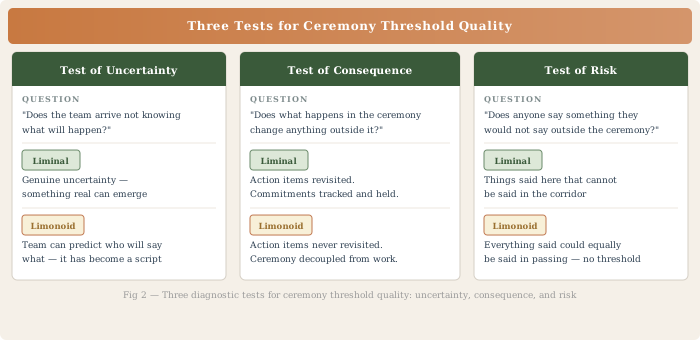
The simplest diagnostic is the test of genuine uncertainty: does the team arrive at the ceremony not knowing what will happen there? If the team can predict with reasonable confidence how the ceremony will go — who will say what, what issues will be raised, what will be agreed and what will be deferred — the ceremony is limonoid. It has become a script rather than a threshold.
A second diagnostic is the test of consequence: does what happens in the ceremony change anything outside it? Action items that are never revisited, commitments that are not tracked, decisions that are made and then quietly reversed without the team's knowledge — these signal that the ceremony has become decoupled from the work it was designed to serve.
A third diagnostic is the test of risk: does anyone say anything in the ceremony that they would not say outside it? If the ceremony has threshold quality, it is a space where things can be said that cannot be said in the ordinary flow of work. If everything said in the retrospective could equally be said in a corridor conversation, the retrospective is no longer serving its threshold function.
Restoring the threshold: structural moves
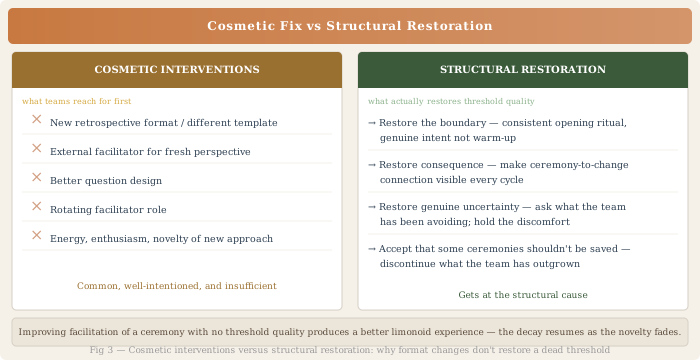
Restoration is structural, not cosmetic. The moves that restore threshold quality work at the level of the boundary, the consequence, and the genuine uncertainty — not at the level of format or question design.
Restore the boundary. Something must mark the entry into the ceremony as different from the entry into ordinary work. This can be as simple as a consistent opening ritual — a moment of silence, a check-in that is not task-related, a physical movement or change of space — provided it is held consistently and with genuine intent rather than treated as a warm-up activity. The boundary marks the threshold. Without it, the ceremony begins in the middle of work and ends there.
Restore the consequence. The team must experience that what happens in the ceremony matters beyond it. This requires the coach or Scrum Master to be rigorous about tracking what was agreed and what changed — and to bring the team into direct contact with the evidence of impact or the absence of it. A retrospective that produces action items that are never revisited has no consequence. Restoring consequence means making the connection between ceremony and change visible, every cycle.
Restore genuine uncertainty. This is the most difficult and the most important. The ceremony must be capable of producing something that was not there before it started — which requires it to ask something that the team does not already know the answer to. This often means asking questions that are slightly uncomfortable, that open territory the team has been avoiding, that require genuine reflection rather than reiteration of the familiar. The facilitator who is not willing to do this will not restore the threshold. They will produce a better limonoid experience.
Why some ceremonies shouldn't be saved
Not every dead ceremony warrants restoration. Some ceremonies have decayed because the team has genuinely moved beyond what the ceremony was designed to address. A team that has developed the capacity for continuous retrospection through its daily work may not need a formal retrospective ceremony. A team that has resolved its planning challenges through better backlog management may find that the refinement ceremony is genuinely redundant.
The question is not whether the ceremony is alive but whether it is serving a genuine need. A ceremony that is held because it is on the calendar, but that the team has outgrown, should be discontinued rather than revived. The energy spent preserving a redundant ceremony is energy not available for the work it is supposed to support. The honest assessment — this ceremony has served its purpose and we are ready to let it go — is itself a kind of threshold crossing: the team acknowledging its own development rather than maintaining the forms of development that preceded it.
Continue Exploring
Go deeper into the work
The Book
The Art of Creating Self-Organizing Teams
The full framework behind this article — contracting, team dynamics, and practical coaching tools for every stage of the journey.
Companion Toolkit
Resistance Radar & Resilience Scorecard
Practical tools for mapping resistance patterns and measuring whether interventions increased capacity — not just compliance.
TA for Agile
Co-creative TA in Agile Contexts
Ego states, psychological contracts, group imago, and the relational concepts that underpin this article — applied to real teams.