When the Healer Inflates
The examined wound is the foundation of coaching authority — but examination is not the same as integration. Coaches who have done personal work without completing it often inflate around the healer archetype: they become the centre of the work rather than its servant, cannot refer without anxiety, and are covertly dependent on their clients' improvement for their own equilibrium. The engagement that should have made itself unnecessary has instead made itself indispensable.
The clients who don't graduate
The engagement is entering its third year. The coach has excellent relationships within the team. The work continues to feel meaningful and productive. New coaching questions are regularly generated. The relationship is warm, the team's regard for the coach is genuine, and the coach's regard for the team is equally genuine.
But the team is not more autonomous than it was a year ago. It still brings the same categories of problem to the coaching space. It still looks to the coach when the discussion reaches a difficult point. The team's capability has improved in measurable ways, and the coach points to this improvement. What has not improved — what has quietly not been designed for — is the team's capacity to function without the coaching relationship. The engagement that should have made itself progressively unnecessary has instead made itself progressively indispensable.
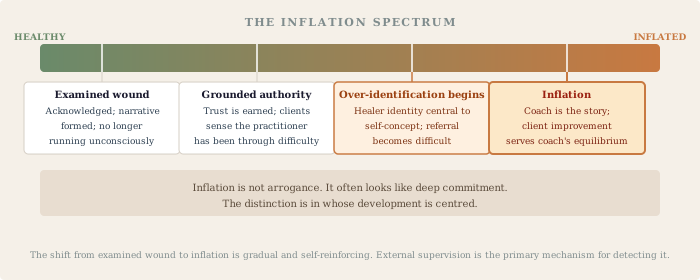
This is coaching inflation in its most common form. It does not look like arrogance. It looks like dedication, care, and genuine contribution. The distinction is not in the behaviour but in whose development the engagement is actually centred on — and whether the coach can see the difference.
What inflation is — and how it differs from confidence
Jung used inflation to describe a specific psychological condition: the ego's identification with an archetype — a universal pattern of the collective unconscious — in a way that temporarily increases the ego's sense of power, rightness, and significance but disconnects it from its own actual scale. The inflated ego is not deluded about its individual qualities. It has taken in more than belongs to it: archetypal energy that creates an experience of exceptional capacity, authority, or mission that the personal ego cannot fully bear.
The healer archetype is one of the most powerful in the human psyche. It carries deep meaning across cultures and centuries: the figure who accompanies others through difficulty, who holds what cannot yet be held by those suffering, who knows the territory of damage and emergence in a way that ordinary life does not require. When a coach identifies with this archetype — when the healer role becomes the organising centre of their professional identity — the inflation risk is structural. The archetype is larger than any individual. Carrying it produces a quality of conviction, purpose, and indispensability that feels like authentic vocation and may contain genuine vocation — but that also makes the coach the necessary centre of the work.
Confidence is different. Confidence is grounded in accurate assessment of one's own capacity — calibrated by evidence, open to revision, proportionate to the situation. Inflation is grounded in identification with something larger: a sense of significance that exceeds what personal evidence can account for and that is maintained by the coaching relationship rather than by the coach's ongoing self-examination.
Guggenbühl-Craig's analysis of power in the helping professions is the most precise account of what inflation produces in practice. He observed that the healer-patient archetype is split in the helping professions: the healer's need to be healed is systematically denied, while the patient's capacity to heal themselves is equally systematically underestimated. The result is a structural asymmetry that maintains the helping relationship beyond its therapeutic necessity.
Three forms coaching inflation takes
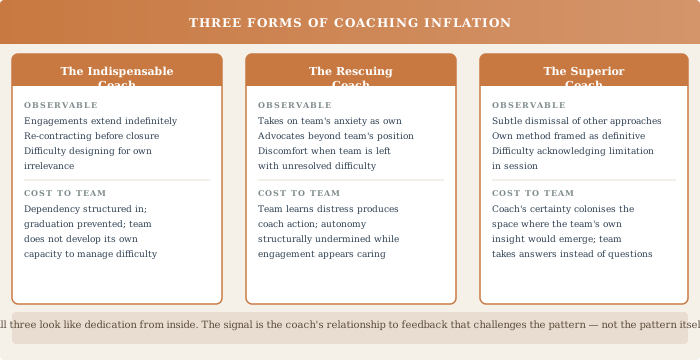
The indispensable coach is the most common form, and the least visible. The engagement extends beyond its natural term. Re-contracting occurs before genuine closure has been attempted. New objectives replace completed ones before the team has had time to consolidate what it has achieved and assess whether it still needs external support. The coach who is uncomfortable with endings — whose belonging complex or healer identity makes the prospect of the team's graduation feel like abandonment rather than success — designs engagements that do not end. The team does not develop its own capacity for the work the coach does, because the coach is always there to do it.
The rescuing coach takes on the team's difficulty as their own problem. When the team is in distress, the inflated rescuer moves toward them with an urgency that goes beyond professional care — that is driven by the coach's own need to be effective in the presence of suffering. The intervention style is highly active: solutions offered before the team has had time to find their own, resources mobilised before the team has recognised its own resourcefulness, problems taken on that belong to the team's development. The team learns that distress produces coach action. The autonomy the team is supposed to develop is structurally undermined throughout.
The superior coach is inflated around knowledge rather than care. The subtle dismissal of approaches that differ from their own, the framing of their method as definitive, the difficulty acknowledging genuine limitation in session — these are the signs of a coach who has identified with the healer archetype at the level of knowing rather than healing. Their certainty colonises the space where the team's own insight would have emerged. The team takes the coach's answers in place of its own questions.
How the team signals it — and why the coach cannot hear the signal
Teams signal coaching inflation reliably, but rarely directly. The signals are subtle because teams are rarely willing to challenge a coach they like, whose contribution they genuinely value, and whose presence has become structurally embedded in how they function.
The most common signal is increasing deference in domains where the team has developed its own competence. The team that was challenging the coach's suggestions in year one now accepts them without much examination. This can look like trust and maturity. It is often the opposite: the team has learned that the coach has a preferred answer and that the path of least resistance is to find it. The critical engagement that genuine development would produce has been replaced by sophisticated performance of collaboration.
A second signal is the pattern of what gets brought to the coaching space versus what is handled without it. In a healthy engagement, teams progressively bring fewer of the problems that earlier required coaching support, because they have developed the capacity to handle those problems themselves. In an inflated engagement, the category of problems requiring coaching support does not narrow. New coaching-relevant problems are reliably generated. The coach interprets this as evidence of the team's growing sophistication and depth. It may be evidence of a different kind.
The reason the inflated coach cannot hear these signals is that the inflation explains them away. Increasing deference is read as trust. Continued dependency is read as ongoing need. The coach who is identified with the healer archetype experiences the team's reliance as evidence that the work is important — not as evidence that the work has structured the reliance in. The signal system that would allow them to notice what is happening is the same system that inflation has distorted.
What supervision needs to do — and why case review misses it
Case review supervision asks: what happened in the session, what did you do, was it effective? This is useful and insufficient. It operates at the level of the coach's practice without accessing the coach's relationship to the healer identity that is organising the practice. The inflated coach can provide excellent case reviews. Their accounts will be thoughtful, nuanced, and consistent with a sophisticated understanding of team dynamics. The inflation is visible not in the content of what they describe but in the structure of how they relate to the work.
Supervision that addresses inflation asks different questions: what does it mean to you when a team no longer needs you? What do you notice in your body when you contemplate closing an engagement that is going well? What is your relationship to the idea that the team's best outcome might be to outgrow you? These questions are not designed to produce insight as quickly as case review. They are designed to access the affective structure — the needs and meanings that have become attached to the healer identity — in a way that allows the coach to examine them rather than being driven by them.
The supervisor who can ask these questions, and who can hold the coach's discomfort with them without resolving it prematurely, is providing what inflation supervision requires. The supervisor who is themselves inflated around the healer identity — or whose supervision has itself become indispensable to the coach — is not positioned to do this work.
Deflation is not the cure
The response to inflation is not self-negation. A coach who swings from inflation to deflation — from identification with the healer archetype to doubt about whether they have anything to offer — has not integrated the pattern. They have moved from one pole to its opposite, which is enantiodromia rather than development.
The goal is differentiation: the capacity to distinguish what belongs to the coach as a person with specific skills, experience, and developmental history from what belongs to the healer archetype that the coach's role activates in the team. The healer archetype is real. The work of Agile coaching genuinely activates it. The team's projections onto the coach are not fantasies — they are responses to something that the role and the coach's presence genuinely carry. The question is not whether to eliminate the archetypal dimension but how to relate to it without identification.
John Beebe's work on integrity in helping professions suggests that the healthy coach maintains access to both the healer and the patient — to both the capacity to hold difficulty and the awareness of their own wounds and limitations. It is not the absence of the wound that produces healthy practice. It is the ongoing, active acknowledgement that the wound is still there — that the coach is not beyond difficulty but is currently managing their own — that keeps the healer identity from inflating into the archetype.
The inflated coach whose teams don't graduate is not a bad coach. They are a coach who has done real work, developed genuine skill, and arrived at a point in their development where the work of examining the work — the relationship to the healer identity, the investment in the team's need, the discomfort with closure — is the next territory. That territory is not different in kind from the territories they have helped their teams enter. The coaching they have needed all along is their own.
Continue Exploring
Go deeper into the work
The Book
The Art of Creating Self-Organizing Teams
The full framework behind this article — contracting, team dynamics, and practical coaching tools for every stage of the journey.
Companion Toolkit
Resistance Radar & Resilience Scorecard
Practical tools for mapping resistance patterns and measuring whether interventions increased capacity — not just compliance.
TA for Agile
Co-creative TA in Agile Contexts
Ego states, psychological contracts, group imago, and the relational concepts that underpin this article — applied to real teams.