The Wicked Problem the Sprint Cannot Solve
Tame problems have identifiable causes, known solutions, and can be resolved through prior experience or analytical method. Wicked problems involve systemic interdependency (you cannot isolate a single cause) and people complexity (multiple stakeholders with incompatible perspectives on what even counts as a problem). Team dynamics are wicked. Sprint velocity is tame. Agile frameworks are designed for tame problems. Coaches who apply tame-problem methods to wicked team dynamics produce partial solutions that generate new problems. Understanding the difference is not academic. It is the most practical thing a coach can know.
The solution that kept moving
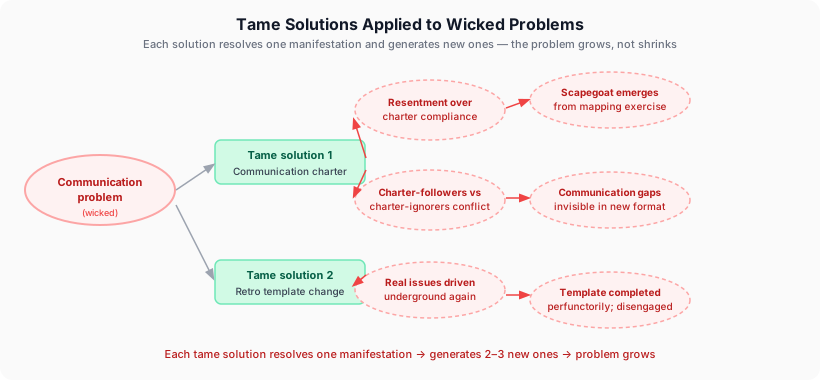
The team had a communication problem. Everyone agreed on this. The coach's first intervention was a team communication charter: agreed norms, signed by all members, posted on the wall. Within three weeks, the charter was being followed by some team members and ignored by others. The ones ignoring it said the charter was too rigid. The ones following it said the problem was enforcement. The communication problem had become a charter compliance problem.
The second intervention was a retrospective format change: a specific communication-focused template that asked team members to identify what information they needed and weren't getting. The template was useful once. By the third use, team members were completing it quickly and moving on. The communication gaps that the template was designed to surface were still present, but they were no longer appearing in the template. The communication problem had become an invisible problem.
Tame problems
In 1973, Horst Rittel and Melvin Webber published a paper in Policy Sciences that introduced a distinction that has become fundamental in planning, design, and systems thinking, and almost entirely absent from Agile coaching discourse. They called it the distinction between tame problems and wicked problems.
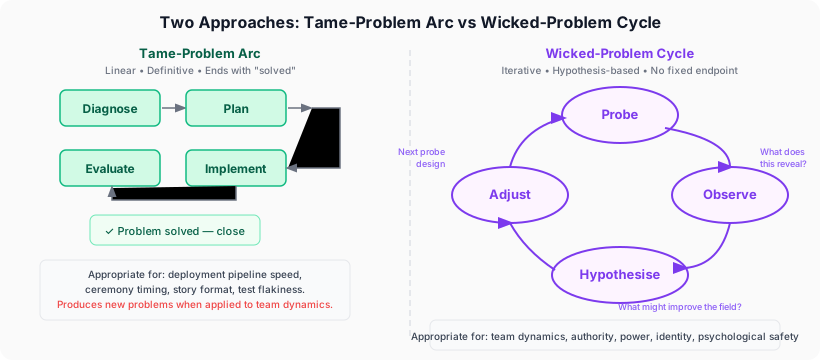
A tame problem is bounded and definable. It has a relatively clear solution space: either you know the solution from prior experience, or you can reason your way to it by applying analytical method. Once a tame problem is solved, it stays solved. The solution can be evaluated as correct or incorrect. Tame problems respond well to method: identify the cause, design a solution, implement, measure, close.
Agile teams have many tame problems. A deployment pipeline that takes 45 minutes is a tame problem — there are known optimisation techniques, measurable outcomes, and a stopping rule (when it takes less than 10 minutes). A ceremony timing that consistently runs over is a tame problem. A story format that is ambiguous is a tame problem. A test suite with too many flaky tests is a tame problem. These problems respond to the standard problem-solving approach because they are, in fact, solvable.
Wicked problems
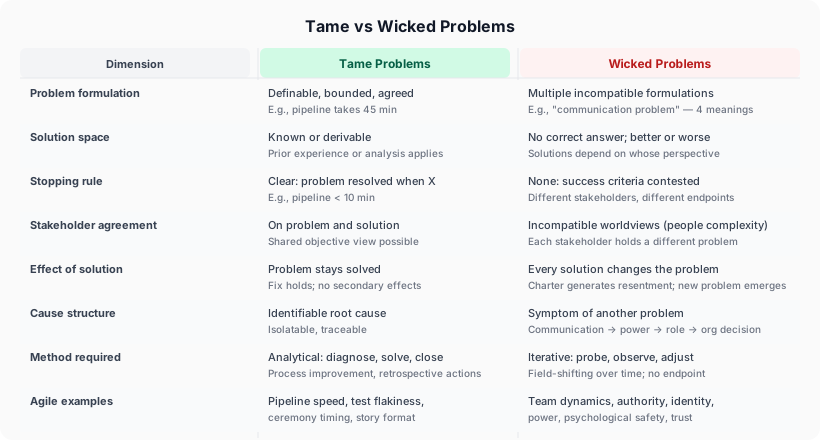
Wicked problems are different in kind, not just in degree of difficulty. Rittel and Webber identified ten properties that distinguish wicked problems from tame ones. Several are directly relevant to team dynamics.
Wicked problems have no definitive formulation. You cannot agree on a precise statement of what the problem is, because different stakeholders have different and incompatible understandings of it. "The team has a communication problem" is not a precise statement — it is a label applied to a phenomenon that means different things to the product owner, the tech lead, the Scrum Master, and the junior developer who is not being heard.
Wicked problems have no stopping rule. You cannot declare a wicked problem solved, because the criteria for success are themselves contested. The communication charter resolves the tech lead's formulation of the communication problem while leaving the junior developer's formulation entirely unaddressed. The tech lead calls it solved. The junior developer does not.
Solutions to wicked problems are not true or false, but better or worse. There is no correct answer to a wicked team dynamics problem, only solutions that are better or worse for particular stakeholders and particular problem formulations. And every solution changes the problem: the communication charter changes the dynamics of who raises communication concerns and how, which changes what the communication problem looks like next month.
Perhaps most importantly: every wicked problem is a symptom of another problem. The communication problem is a symptom of a power imbalance. The power imbalance is a symptom of an unclear role structure. The unclear role structure is a symptom of an organisational decision made two years ago. The coach who solves the communication problem without attending to its roots will find the problem re-surfacing one layer up.
People complexity and systemic complexity
Michael Jackson's critical systems thinking adds two further dimensions that are particularly useful for coaching practice. People complexity describes situations in which stakeholders have incompatible worldviews about what the problem even is — not just incompatible solutions, but incompatible problem formulations. Systemic complexity describes situations in which the problem is interdependent with other problems in ways that make isolation impossible.
Team dynamics problems typically exhibit both. The communication problem has people complexity: the tech lead's formulation (we need clearer decision-making protocols) and the junior developer's formulation (I am being systematically excluded from technical conversations) are not different perspectives on the same problem — they are different problems, formulated from different positions in the team's power structure. A solution that addresses the tech lead's formulation may actively worsen the junior developer's problem.
The same communication problem has systemic complexity: it is interdependent with the team's authority structure, the product owner's relationship with the team, the senior engineer's technical identity, and the organisation's norms about how disagreement is expressed. You cannot fix the communication problem without touching these interdependent systems, and touching any one of them changes the others.
Why tame solutions applied to wicked dynamics produce new problems
The coach who applies a tame solution to a wicked problem does not fail to solve the problem — they solve one formulation of it while generating new problems from the interdependent systems they have disturbed. The communication charter resolves the tech lead's formulation and generates resentment from team members who experience it as surveillance. The retrospective template surfaces one class of communication gap and drives another underground. The stakeholder mapping exercise creates a new dynamic in which one stakeholder becomes the identified scapegoat.
This is not a failure of method. The methods are perfectly adequate for tame problems. It is a category error — applying methods designed for one category of problem to a problem in a different category.
What wicked-problem approaches look like
Wicked-problem approaches start with a different assumption: the goal is not to solve the problem but to improve the situation — and improvement is always partial, temporary, and perspective-dependent. This is not a counsel of defeat. It is an accurate description of what is possible with wicked problems, and what progress actually looks like.
Wicked-problem approaches are iterative rather than definitive. Each intervention is a hypothesis rather than a solution — this change might improve the situation for these stakeholders in this respect, at the cost of these other effects. The hypothesis is tested, the effects are observed, and the next hypothesis is adjusted accordingly. This is a diagnostic orientation rather than a solution orientation.
Wicked-problem approaches hold multiple perspectives simultaneously rather than converging on a single formulation. The coach who can hold the tech lead's formulation and the junior developer's formulation at the same time — without requiring them to agree on the problem before intervening — is working at the appropriate level of complexity for the problem they are addressing.
Wicked-problem approaches design interventions to shift the field rather than to solve the problem. The coach working at the field level is not trying to fix the communication dynamic — they are trying to create conditions in which the communication dynamic can shift: a different kind of meeting, a different authority structure, a different conversational norm that changes the relational field in which the communication problem lives.
Three practical moves
Diagnose tame vs wicked before choosing method. Before deciding what to do about a team problem, ask: can this problem be precisely formulated in a way that all relevant stakeholders would agree with? Is there a stopping rule — a condition that would allow us to declare it solved? If the answer to either question is no, the problem is wicked, and tame methods will generate new problems faster than they resolve existing ones.
For wicked problems, contract for ongoing engagement not a deliverable. The expectation of a deliverable — a communication charter, an improved retrospective format, a team health score improvement — is the signature of tame-problem contracting applied to a wicked-problem engagement. Contracting for a wicked problem means agreeing on an ongoing engagement that will involve iterative hypothesis-testing, multiple perspectives, and no definitive endpoint. This is a different conversation with the sponsor, and it needs to happen early.
Treat every intervention as a probe — observe what it produces, adjust. The distinction between a solution and a probe is a mindset shift with significant practical consequences. A solution is evaluated against whether it achieved its intended outcome. A probe is evaluated against what it revealed about the system — including the new problems it generated. The communication charter that generated resentment is not a failed solution. It is a probe that revealed that the team's power dynamics are more complex than the initial formulation suggested. That information is valuable for the next hypothesis.
The sprint cannot solve what the team is
Agile frameworks are designed for tame problems. They are superb instruments for managing iterative development of bounded technical problems. They provide minimal guidance about wicked team dynamics, not because the frameworks are incomplete, but because wicked problems cannot be solved by framework application — they require a fundamentally different orientation.
The coach who cannot distinguish a tame problem from a wicked one will keep reaching for solutions that work for the wrong category. The communication charter, the retrospective template, the stakeholder map are all legitimate tools for tame problems. Applied to wicked team dynamics, they solve one manifestation and generate two more. The sprint can surface the wicked problem. It cannot solve it.
This is not pessimism. It is an accurate understanding of what wicked problems are and what progress with them looks like. The coach who enters a wicked-problem engagement with the right orientation — iterative hypothesis, multiple perspectives, field-shifting rather than problem-solving — will produce better outcomes than the coach who repeatedly applies tame methods and is confused by why they don't hold.
Continue Exploring
Go deeper into the work
The Book
The Art of Creating Self-Organizing Teams
The full framework behind this article — contracting, team dynamics, and practical coaching tools for every stage of the journey.
Companion Toolkit
Resistance Radar & Resilience Scorecard
Practical tools for mapping resistance patterns and measuring whether interventions increased capacity — not just compliance.
TA for Agile
Co-creative TA in Agile Contexts
Ego states, psychological contracts, group imago, and the relational concepts that underpin this article — applied to real teams.