Looking for Trouble: Why the Hardest Moment Is Often the Learning Edge
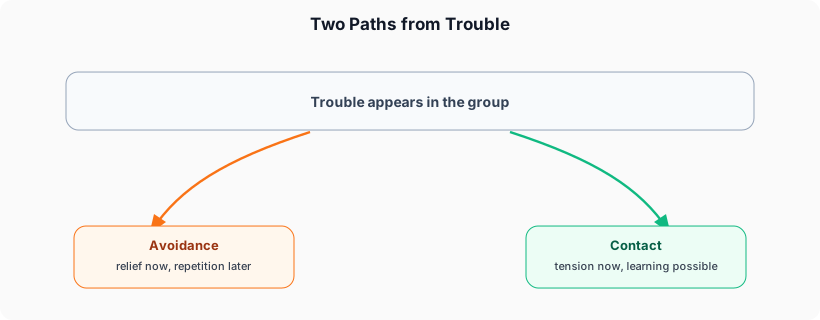
The coach's job is not to smooth the group too quickly. In teams that are trying to learn, the trouble is often where the developmental task appears. Premature reassurance can protect the team from the very material it needs.
A familiar Agile scene
A retrospective reaches the point everyone recognises. The team has named the dependency on architecture review. The architect is in the room. The product manager says, 'Let's not make this personal.' The Scrum Master moves quickly to dot voting.
The meeting stays safe in the shallow sense. It also misses the learning edge. The trouble was not a distraction from the retrospective. It was the retrospective.
1. Trouble is often where learning appears
Landaiche writes about looking for trouble in groups intended for professional development. The phrase does not mean provoking conflict for its own sake. It means deliberately making contact with the area of greatest difficulty because that is where the group's needed learning may be located.
Agile facilitation often rewards smoothness. The meeting ends on time, the board is updated, the mood is preserved. But a team can be smoothly defended. The coach needs to know when smoothness is helping work continue and when it is preventing learning.
2. The productive turbulence zone
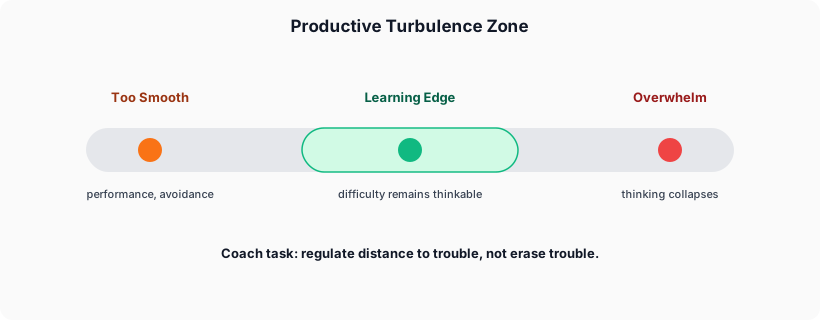
Not all trouble is useful. Too little disturbance and the team performs familiar agreement. Too much disturbance and thinking collapses. The coach is looking for the middle zone where discomfort is real but the group can still observe itself.
This is why technique alone is insufficient. The same question can be a useful challenge in one team and an injury in another. The coach must assess the group's current capacity before deciding how close to the trouble to move.
3. Practical coaching moves
The coach can slow the escape without forcing exposure. Useful phrases include: 'Something important may have just appeared; can we stay with it for one minute?' or 'Before we turn this into an action item, what makes this hard to discuss?'
The move is small but significant. It tells the team that difficulty is not automatically a process failure. Difficulty can be data.
Pause the procedural move that would end the discomfort too quickly.
Name the moment as potentially important without assigning blame.
Ask what the group is protecting by moving away.
Return to task after meaning has been made, not before.
4. Boundary note
Looking for trouble is not a mandate to push past consent. If the group cannot think, breathe, or choose, the coach has left learning and entered harm. The standard is not intensity; it is usable contact with reality.
Where To Go Next
Read this when trouble appears as pushback against change.
Use this as the wider conceptual map for the Transactional Analysis pathway.
Continue Exploring
Go deeper into the work
The Book
The Art of Creating Self-Organizing Teams
The full framework behind this article — contracting, team dynamics, and practical coaching tools for every stage of the journey.
Companion Toolkit
Resistance Radar & Resilience Scorecard
Practical tools for mapping resistance patterns and measuring whether interventions increased capacity — not just compliance.
TA for Agile
Co-creative TA in Agile Contexts
Ego states, psychological contracts, group imago, and the relational concepts that underpin this article — applied to real teams.