Back to Insights
    7 April 2026·30 min read

    Beyond Retros and Rituals: Co‑creative TA as a Relational Lens for Agile Team Coaching

    Nine recurring team‑coaching challenges mapped to co‑creative Transactional Analysis — with a practitioner toolkit, boundary conditions, and an honest look at the evidence.

    Co-creative TATeam CoachingAgileContractingPsychological Safety

    Abstract

    Agile frameworks prescribe roles, ceremonies, and artefacts, yet recurring team breakdowns — silence in retrospectives, blame cycles, dependency on the coach, decision paralysis — are relational phenomena that process improvements alone cannot resolve. This article proposes co‑creative transactional analysis (TA), as formulated by Summers and Tudor (2000, 2014), as a disciplined sense‑making and intervention lens for Agile team coaching. Drawing on co‑creative TA theory, Robinson's (2020) work on cocreative transformational learning, organisational TA literature, and practitioner research on symbiotic dynamics in organisations, the article maps nine recurring challenge areas in Agile teams to specific co‑creative TA concepts and intervention directions. Four areas are explored in depth: multiparty contracting breakdowns, rescue and dependency dynamics, psychological safety as a recognition economy, and persistent stuckness and impasse. The article offers a practitioner toolkit, discusses boundary conditions and ethical safeguards, and identifies research gaps that invite empirical investigation.

    1. Introduction: The Relational Blindspot in Agile Coaching

    Agile software development, and the broader Agile movement that has followed it into product management, marketing, and organisational design, rests on a distinctive set of relational assumptions. The Scrum Guide describes Scrum Teams as "cross‑functional" and "self‑managing," with no sub‑teams or hierarchies (Schwaber & Sutherland, 2020). The Agile Manifesto privileges "individuals and interactions over processes and tools." Psychological safety — the shared belief that the team is safe for interpersonal risk‑taking (Edmondson, 1999) — is routinely cited as a prerequisite for the close communication, candour, and experimentation that Agile requires (Thorgren & Caiman, 2019).

    Yet when Agile coaches describe their most persistent challenges, what they describe are relational phenomena: teams that go silent when asked for honest feedback; Product Owners and developers locked in covert authority struggles; coaches who find themselves carrying messages nobody will say directly; retrospectives that produce the same themes for months; sponsors who demand "self‑management" while exercising command‑and‑control escalation. These patterns are not solved by better ceremonies, new estimation techniques, or another round of working agreements. They are patterns in how people relate — to each other, to authority, to risk, to recognition, and to the very idea of shared ownership.

    The Agile coaching literature is not unaware of this. Adkins (2010) discusses coaching stance and facilitation depth. Systems coaching approaches such as Organisation and Relationship Systems Coaching (ORSC) frame the relationship system itself as the client. Systemic team coaching (Hawkins, 2017) emphasises working with the whole team over time, including stakeholder engagement. Yet a systematic review of large‑scale Agile transformations found that approximately 90% of included papers were experience reports, highlighting a lack of sound academic research on how to work with these dynamics (Dikert, Paasivaara, & Lassenius, 2016). The evidence base for relational intervention in Agile contexts remains thin.

    This article proposes co‑creative transactional analysis as one response to that gap. Co‑creative TA, as formulated by Summers and Tudor (2000, 2014), offers a relational, systemic way of reading "what's happening between us, right now" — and treats patterns in communication, meaning‑making, and role relations as co‑constructed in a shared field, rather than located "inside" individuals. The claim is not that TA is the only or best relational lens; it is that co‑creative TA provides a distinctive combination of explicit contracting discipline, micro‑transactional pattern reading, a coherent theory of recognition (strokes), discounting, and games, and a field‑based stance that treats the coach as a participant in the dynamics, not as a neutral observer above them.

    The article draws on four bodies of material: the co‑creative TA formulation itself (Summers & Tudor, 2000, 2014); Robinson's (2020) application of co‑creative TA to transformational learning; organisational and systemic TA literature (Schmid; Mohr & Steinert; Mellor & Schiff, 1975; Erskine & Zalcman, 1979; Steiner, 1974/1990); and practitioner research on symbiotic relationship dynamics, contracting, and measurement in organisational teams. It is intended for Agile coaches, team coaches, Scrum Masters, and organisational development practitioners — readers who may not have formal TA training but who recognise in their daily practice the relational dynamics described here.

    2. What Is Co‑creative TA — and What Makes It Different?

    Transactional analysis, as originated by Eric Berne (1961, 1964), offers a set of interconnected models for understanding personality (ego states), communication (transactions), life patterns (scripts), and repetitive interpersonal dynamics (games). Classical TA was developed primarily in psychotherapy and tends to locate these phenomena inside individuals — a person has a dominant Parent ego state, plays a particular game, carries a script decided in childhood.

    Co‑creative TA, articulated by Summers and Tudor (2000) and elaborated in their subsequent work (Tudor & Summers, 2014), represents a significant philosophical reorientation. Grounded in field theory and social constructionism, co‑creative TA reframes TA concepts as co‑created, present‑centred phenomena. Ego states, scripts, transactions, and games are not properties of individuals but emergent features of a shared relational field. Meaning is not discovered; it evolves through dialogue. The relationship is more potent than either party alone.

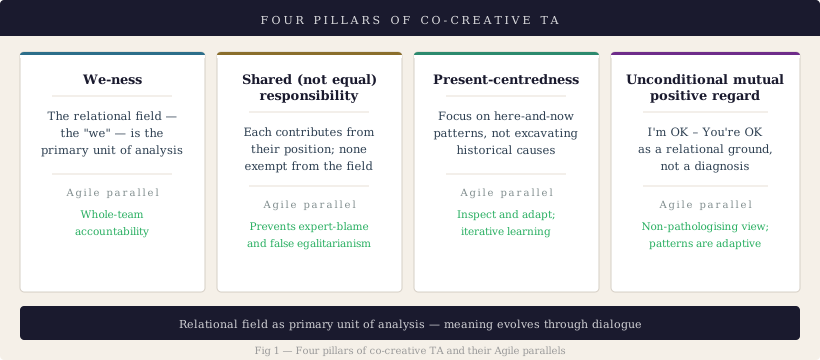
    Four pillars distinguish the co‑creative stance and give it particular relevance for Agile team coaching:

    We‑ness. Co‑creative TA holds that the relational field — the "we" — is the primary unit of analysis. This is not merely a feel‑good sentiment; it is a methodological commitment. When a team is stuck, the question is not "who is the problem?" but "what are we co‑creating that produces this stuckness?" This directly parallels Agile's emphasis on whole‑team accountability and systems thinking, while providing more granular tools for investigating how "whole‑team" breaks down in practice.

    Shared (not equal) responsibility. Each participant contributes to the co‑created field from their position. A sponsor's contribution is not the same as a junior developer's, and a coach's contribution is not the same as a Product Owner's. But each bears a share of responsibility for the dynamics that emerge. This principle prevents both expert‑blame ("the team is dysfunctional") and the false egalitarianism ("everyone is equally responsible") that often accompanies self‑management rhetoric.

    Present‑centredness. Co‑creative TA focuses on here‑and‑now patterns rather than excavating historical causes. In team coaching this is critical: the coach is not investigating who made a bad decision three sprints ago, but noticing what is happening in the room right now — who speaks, who falls silent, what happens when disagreement surfaces, how authority is enacted in real time. This orientation fits Agile's iterative, inspect‑and‑adapt philosophy and keeps interventions grounded in observable behaviour.

    Unconditional mutual positive regard. The I'm OK–You're OK position (Harris, 1969) is treated not as a psychological diagnosis but as a relational ground — the stance from which Adult‑to‑Adult exchange becomes possible. In team coaching, this translates to the coach holding a non‑pathologising view of the team: patterns are understood as adaptive solutions to real pressures, not as defects to be corrected.

    Four pillars of co‑creative TA: We‑ness, Shared responsibility, Present‑centredness, Unconditional mutual positive regard
    Figure 1 — Four pillars of co‑creative TA

    Robinson (2020) extends this framework into learning environments, demonstrating that co‑creative TA can function not only as a therapeutic methodology but as a learning and change methodology. His work on cocreative transformational learning — connecting co‑creative TA with Mezirow's (2000) transformational learning process and constructivism (von Glasersfeld, 1990) — provides a direct bridge to Agile team coaching. Agile teams are, in principle, continuous learning systems. Robinson shows that cocreative conditions — shared responsibility for learning, present‑centredness, explicit permissions, integrating Adult–integrating Adult transactions — produce measurable differences in engagement, safety, and the capacity for transformational change. The conditions he describes are strikingly similar to what Agile coaches aspire to create, and his methodology offers a more precise language for doing so.

    3. The Cocreative Learning Contract

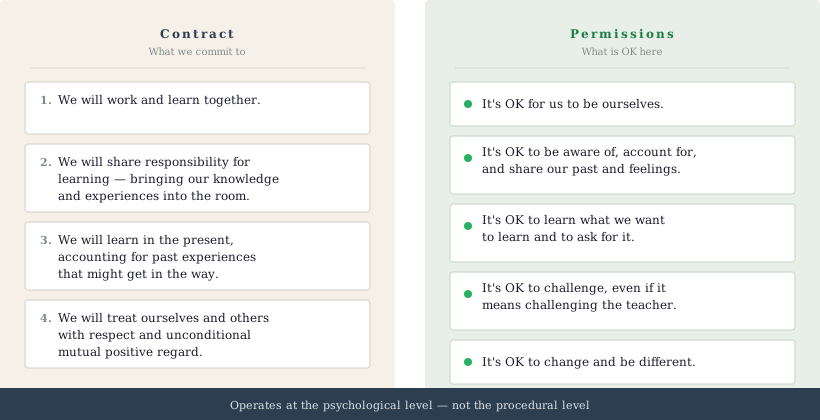
    One of Robinson's (2020) most practically transferable contributions is the cocreative learning contract and its associated permissions. Developed over eight years of work with personal development groups, the contract was designed to operate at the psychological level — addressing not what we will do procedurally, but how we will relate while doing difficult work.

    The contract consists of four elements:

    1. We will work and learn together.
    2. We will share responsibility for the learning to take place. We will willingly bring our own knowledge and experiences into the room and share them in order to enable and support learning.
    3. We will learn in the present, noticing and accounting for past experiences (of learning) that might get in the way of our learning.
    4. We will treat ourselves and others with respect and unconditional (mutual) positive regard.

    Robinson supplements these with five associated permissions:

    • It's OK for us to be ourselves.
    • It's OK to be aware of, to account for, and (if we want) to share our past, including our thoughts and feelings.
    • It's OK to learn what we want to learn and to ask for it.
    • It's OK to challenge if we don't agree or to share a different perspective, even if it means challenging the teacher.
    • It's OK to change and to be different from how we have been in the past.
    Cocreative learning contract elements and five associated permissions
    Figure 2 — Cocreative learning contract and permissions

    When Robinson invited his group to identify what had enabled their transformational learning, they generated two lists: one of positive attributes present in the space and the other of things absent. The positive list included protection, confidentiality, permissions, respect, contracts, boundaries, OKness, safety, strokes, structure, intimacy, integrating Adult transactions, permission to make mistakes, and positive games. The absence list included distraction, judgment, discounting, negative games, rackets, unconditional negative strokes, criticism, one‑upmanship, competition, and drama triangle behaviour. Participants emphasised that while many of the positive attributes were nominally present in other learning environments, they were experienced only at the administrative or professional level, not at the psychological level. The feeling of safety and the level of intimacy and OKness were identified as the major influencing factors.

    For Agile team coaching, this is directly applicable. Most Agile teams have working agreements — "we start on time," "cameras on," "no interrupting." These operate at the procedural level. Robinson's cocreative contract operates at the psychological level, addressing the relational preconditions that determine whether working agreements are lived or merely posted. An Agile team coach adapting this approach might contract with the team:

    • We will share responsibility for solving our problems, not wait for the coach or manager to solve them for us.
    • We will attend to what is happening between us right now, not only to task progress.
    • It's OK to name what isn't working, even if the person responsible is in the room.
    • It's OK to not know, and to ask for help without it being a sign of incompetence.

    The shift from procedural to psychological contracting is, in the author's experience, one of the highest‑leverage moves available to an Agile team coach — and one that co‑creative TA provides explicit language and methodology for enacting.

    4. A Challenge Map for Agile Team Coaches

    Before entering detailed analysis, it is useful to map the terrain. Drawing on the research underpinning this article, nine recurring challenge areas in Agile team coaching have been identified, each with a corresponding co‑creative TA lens. The table below provides a summary; four areas are then explored in depth.

    Challenge areaHow it typically appearsCore co‑creative TA lens
    1. Multiparty contracting breakdownsLeadership keeps interrupting; teams feel set up to fail; sponsors want predictability while teams hear 'be adaptive'Three‑cornered contract; multi‑level contracting
    2. Authority and role ambiguityPO vs team decision fights; SM as process police; managers override despite 'empowerment' rhetoricRole model (systemic TA); background levels
    3. Cross‑functional boundary tensions'Dev vs Product vs QA'; handoff conflicts; dependency blamingTransactions and discounting across boundaries; recognition scarcity
    4. Psychological safety breakdownsSilence in retros; fear of blame; 'no surprises' culture; feedback avoidanceStrokes and stroke economy; discounting
    5. Covert conflict and 'Agile games'Passive aggression; ritual compliance; blame cycles; escalation via backchannelsGames; ulterior transactions; racket system
    6. Rescue, dependency, and over‑functioningCoach rescues team; PO thinks for team; 'experts' as single points; learned helplessnessSymbiosis; passivity; drama roles
    7. Discounting and passivity loops'We can’t influence that'; complaining without experimenting; analysis paralysisDiscounting matrix; passive behaviours
    8. Persistent stuckness and impasseSame retro themes repeating; 'we tried that'; decision deadlocksImpasse; racket system; present‑centred development
    9. Coach entanglement and parallel processCoach becomes messenger, scapegoat, or ally; sponsor uses coach to control teamCo‑created field; three‑cornered contract; supervision

    These nine areas are not independent; they interlock. A multiparty contracting breakdown often produces authority confusion, which feeds rescue dynamics, which generates discounting and passivity, which shows up as stuckness. The co‑creative TA stance treats these interconnections as features of a shared field, not as a causal chain to be debugged in sequence.

    5. Multiparty Contracting: Who Is Contracting with Whom, for What?

    Perhaps no concept in TA has more immediate practical leverage in Agile team coaching than the three‑cornered contract. Originating with English (1975) and developed extensively by Hay (1995), the three‑cornered contract highlights that in any practitioner–client relationship embedded within an organisation, there are at least three parties: the practitioner (coach), the direct client (team), and the contracting authority (sponsor, leadership, HR). Each party has expectations, success criteria, and anxieties — and these frequently conflict.

    In Agile transformations, this triangle is especially volatile. Leaders may want predictability and speed. Teams may want protection and autonomy. HR may want role clarity. Product management may want output. Engineering may want technical sustainability. The Agile coach may be expected to satisfy all of these simultaneously, often without explicit acknowledgement that they are in tension.

    Hay (1995) distinguishes three levels at which contracting operates: procedural (logistics, schedules, deliverables), professional (scope of work, competence, methods), and psychological (covert expectations, fears, hopes, hidden success criteria). In the author's experience, Agile coaching engagements routinely contract at the first two levels and almost never at the third. The result is predictable: the engagement proceeds on the basis of explicit agreements while being sabotaged by implicit ones.

    Co‑creative TA adds a further dimension. Because meaning is understood as co‑created through dialogue, the contract is not a document to be signed and filed; it is a living, evolving negotiation that is enacted moment‑by‑moment. The coach works not only with what was agreed, but with how contracting is enacted in practice — who gets to redefine scope, whose success criteria are treated as real, what is unsayable between sponsor and team. When a sponsor says "we want the team to be empowered" while simultaneously requiring weekly status reports and escalation on any deviation from plan, the mismatch is not a bug in the contract; it is the contract, at the psychological level.

    Practical interventions include:

    Three‑cornered re‑contracting. The coach facilitates a session with sponsor and team present: "What are you (sponsor) hoping this coaching engagement will produce? What are you (team) hoping it will produce? Where might those hopes be in tension? What would each of you need to see in three months to feel this was worthwhile? And — importantly — what must not happen?" This last question often surfaces the most critical psychological‑level material.

    Making the psychological contract visible. Drawing on Rousseau's (1995) psychological contract theory — individual beliefs about reciprocal obligations — the coach might ask: "What do you believe has been promised to you by adopting Agile ways of working? What have you promised in return? And what happens if those promises aren't kept?" In the author's experience, this question frequently reveals that different parties hold fundamentally incompatible beliefs about what "Agile" means, and that no one has named the incompatibility.

    Contracting for confidentiality and reporting. What will the coach share with sponsors? In what form — themes or attributions? Under what conditions? If the team discovers the coach is reporting individual behaviours to management, the coaching relationship is finished. If the sponsor receives no information at all, the engagement loses organisational support. Explicit contracting on this boundary is essential and is directly supported by TA contracting theory.

    The boundary condition is important: contracting clarity helps when confusion is maintained by mixed messages and hidden agendas. It helps less when the sponsor's intent is control rather than development. In such cases, the most useful coaching intervention may be to diagnose that the engagement itself is structurally incoherent and to renegotiate or, if necessary, exit.

    6. Rescue, Dependency, and Symbiosis

    "The team won't take ownership." This may be the single most common complaint in Agile coaching. Scrum Masters remove impediments that teams could address themselves. Product Owners make decisions that teams should own. Technical leads hoard design authority. Meanwhile, team members wait for instructions, ask permission for routine choices, defer to the loudest voice, and complain about lack of empowerment while declining opportunities to exercise it.

    Classical Agile coaching responses — "empower the team," "step back," "let them fail safely" — often assume the problem is one‑directional: someone is controlling too much, or someone is not stepping up enough. Co‑creative TA reframes this fundamentally. Dependency is not a team defect; it is a co‑created relational structure in which all parties have a stake.

    Schiff (1975) describes symbiosis as a pattern in which two or more people function as if they were one complete person, each discounting complementary ego states. In organisational terms, this manifests as role‑based enmeshment: a manager who over‑functions (doing the thinking, deciding, protecting) paired with team members who under‑function (waiting, adapting, complaining). Both sides maintain the arrangement because it meets psychological needs. The manager feels needed, competent, heroic — the Rescuer payoff in Karpman's (1968) drama triangle. The team feels safe from failure, free from the anxiety of genuine autonomy — the Victim payoff, or more precisely, the predictability payoff of a known pattern. Both avoid confronting the discomfort of Adult‑to‑Adult negotiation under real uncertainty.

    Mellor and Schiff (1975) link this to four passive behaviours: doing nothing, overadaptation, agitation, and incapacitation. These are not character flaws but ineffective problem‑solving strategies maintained by discounting — treating some aspect of self, others, or reality as less significant than it is. A team that says "we can't influence the architecture" may be discounting its own capability, the significance of its perspective, or the possibility that the constraint is negotiable.

    Co‑creative TA's distinctive question cuts through this: "What are we co‑creating that makes rescuing the stable solution?" This question implicates everyone — the rescuer, the rescued, the organisational structures that reward over‑functioning, and the coach who may (without awareness) be participating in the same dynamic.

    Practitioner research on symbiotic dynamics in organisations offers vivid illustrations. Consider the pattern of the "micromanaging mentor": a team lead who reviews all code, attends every meeting, and answers client questions on the engineer's behalf — all framed as support and mentoring. The engineer becomes passive, rarely suggests solutions, and constantly seeks approval. The lead is overloaded. Both are unhappy, but neither changes, because the arrangement delivers reliable payoffs: the lead feels indispensable, the engineer feels safe. The intervention that worked was an explicit dyadic contract: the lead gave explicit permission ("You have my OK to design it your way; even if it's not how I'd do it, that's fine if it meets requirements"), set defined checkpoints rather than continuous oversight, and committed to treating mistakes as learning rather than failure. Crucially, protection was built in: "If something goes wrong, I'll support you and we'll fix it together." Over eight weeks, the engineer's confidence and output grew significantly; the lead found new professional satisfaction in seeing growth rather than in being needed. But the transition was not smooth — it required the lead to tolerate imperfection and to renegotiate her own professional identity.

    Another illustrative pattern is the team trapped in an approval bottleneck. A fintech Scrum team's Definition of Done included "Approved by Product Steering Committee," meaning every increment required a weekly committee review. The team stopped suggesting improvements ("why bother if it'll get overruled"), the product owner acted as a middle‑man, and cycle time stretched to weeks. The intervention combined a delegation matrix — clarifying which decisions the team could make autonomously, which required advice, and which needed formal approval — with a redefined Definition of Done: "Demo to stakeholders for feedback" instead of formal approve/reject. Over three months, cycle time dropped dramatically, team morale spiked, and the steering committee was eventually dissolved for all but major strategic decisions.

    These cases illuminate the practical apparatus available for working with dependency patterns:

    Delegation Levels Matrix. Drawing on Appelo's (2011) seven levels of delegation (Tell, Sell, Consult, Agree, Advise, Inquire, Delegate), coach and team — including the manager or sponsor — map key decisions onto the spectrum. The exercise itself surfaces assumptions: a manager who believes "I decide hiring" may discover the team wants at least Consult level. A team that assumes "we can't change the tech stack" may discover the constraint is less rigid than believed. The matrix becomes a living artefact, revisited as trust and capability grow.

    "From rescue to request." The coach helps the team shift from indirect, passive communication ("things are blocked," "we're waiting") to direct request and offer language ("I'm requesting a decision on X by Tuesday"; "I'm offering to handle Y if you'll commit to Z"). This is transactional work in the most literal TA sense — redesigning the transactions that maintain the current pattern.

    Symbiosis, drama triangle, and the co‑creative exit
    Figure 3 — Symbiosis, drama triangle, and the co‑creative exit

    Autonomy with protection. Co‑creative TA explicitly warns against removing support faster than people can build internal capacity. Graduated autonomy requires a parallel commitment from sponsors: what risks will the organisation absorb while the team learns? If mistakes are punished as soon as the manager steps back, the team will rightly return to dependency. An intervention that pushes autonomy without contracting for protection is not empowerment; it is abandonment.

    7. Psychological Safety as a Stroke Economy

    "Create psychological safety" has become the most common aspiration in Agile coaching — and perhaps the most frequently misunderstood. Edmondson's (1999) original concept is precise: psychological safety is a shared belief that the team is safe for interpersonal risk‑taking. But in Agile coaching practice, it is often treated as a norm to be declared ("we have a safe space"), a temperature to be measured ("safety check: green, yellow, red"), or a leader behaviour to be modelled ("thank people for speaking up"). These are helpful but insufficient. They address the surface structure of safety while leaving the underlying economy untouched.

    Co‑creative TA offers a more structural account through the concept of strokes — units of recognition, as defined by Steiner (1974/1990). Steiner argues that humans need recognition the way they need food, and that in most social environments, an implicit "stroke economy" operates: a set of inhibiting rules that restrict the giving and receiving of positive recognition, increase stroke hunger, and drive substitute behaviours including the pursuit of negative strokes (criticism, conflict, drama) as alternatives to the missing positive ones.

    Applied to Agile teams, this lens reveals dynamics that norm‑setting cannot reach. Under delivery pressure, teams often develop a recognition economy in which certain contributions are visible and rewarded (shipping features, hitting sprint commitments, heroic firefighting) while others are invisible (quality maintenance, defect prevention, mentoring, documentation, emotional labour in cross‑functional negotiation). The "stroke economy" is not a metaphor; it is observable in who gets mentioned in stand‑ups, who is credited in demos, whose work is treated as interesting versus boring, whose concerns are heard versus dismissed.

    When positive recognition is scarce, people pursue substitute strokes. A developer who never receives recognition for careful code review may resort to public criticism of others' code — a negative stroke, but at least a stroke. A team member who is never acknowledged for raising risks may stop speaking altogether (choosing stroke withdrawal over the vulnerability of speaking into a void). A Product Owner who receives recognition only for throughput will learn to discount quality concerns, regardless of what the working agreement says about "quality built in."

    The co‑creative TA stance adds a critical further dimension: safety is not a property of the environment that the coach or leader installs; it is co‑created in the moment. Every meeting, every stand‑up, every retrospective is a micro‑negotiation of the recognition economy. When a team member shares a concern and the leader responds with curiosity ("Tell me more — that's important"), a positive stroke is exchanged and the safety contract is reinforced. When the leader responds with defensiveness ("That's already been decided"), a discount occurs and the safety contract is eroded. These micro‑transactions aggregate into the team's lived experience of safety, which no annual survey can fully capture.

    Practical interventions include:

    Stroke audit. The coach facilitates a team exercise: what gets recognised in this team? What contributions are invisible? Where do we rely on negative strokes (complaints, blame, sarcasm) as substitutes for missing positive ones? This exercise is often revelatory — teams discover that entire categories of work (testing, documentation, cross‑team coordination) receive zero recognition, and that the people doing that work are the least engaged.

    Leader–team re‑contracting. The coach works with the team leader (or Product Owner, or Scrum Master) on specific commitments: "When someone raises a risk, I will respond with a question before I respond with a decision." "When someone admits a mistake, I will ask what we can learn before I ask what went wrong." These are not personality changes; they are contracted transactional shifts — redesigning the micro‑exchanges that constitute the recognition economy.

    Observation without labelling. The coach tracks interaction patterns in meetings using a structured checklist: Who spoke? Who was interrupted? How were decisions made — by authority, by consensus, by silence? What happened when disagreement surfaced? Were there moments of seeking approval ("Is that okay with you?") versus autonomous proposing ("I think we should do X because…")? This data, shared with the team without attribution, provides evidence for reflection: "I noticed that in today's meeting, four questions were directed to the manager that the team could have answered. What does that tell us?"

    The boundary condition is essential. If psychological safety problems are driven by concrete organisational punishment — performance management systems that penalise risk‑taking, blame cultures with real career consequences — then working with the stroke economy is necessary but insufficient. The coach risks colluding with "be brave" messaging in a genuinely unsafe environment. In such cases, organisational TA insists on diagnosis at the system level: the intervention must include work with sponsors and governance structures, not only with the team's internal dynamics.

    8. Stuckness, Games, and Impasse

    Every experienced Agile coach knows the phenomenon: the retrospective produces the same themes — "too many meetings," "unclear priorities," "technical debt" — sprint after sprint, quarter after quarter. Action items are generated, sometimes attempted, rarely sustained. The team is not lazy or resistant. It is in impasse.

    TA literature treats impasse as a state of stuckness in which competing forces create a deadlock. Mellor (1980) and Petriglieri (2007) articulate three degrees of impasse, each involving a different kind of internal or relational conflict. While their clinical formulations are not directly transferable to organisational settings, the underlying principle is: stuckness is meaningful data about what change would threaten. A team that cannot resolve "unclear priorities" may be avoiding a confrontation with the Product Owner whose authority is ambiguous and whose response to challenge is unpredictable. A team that perpetually laments "too many meetings" may be displacing frustration about meaningless coordination that no one feels empowered to refuse. The impasse is not inertia; it is a system‑stabilising compromise between competing imperatives, and it will persist until the competing forces are named and the costs of stuckness exceed the costs of change.

    Co‑creative TA enriches this analysis through the concept of games — recurring, patterned series of transactions that serve stroke procurement and script confirmation (Berne, 1964). A game is not a one‑off conflict; it is a stable interaction pattern with payoffs. In Agile teams, common games include:

    • "Yes, but…" — the team generates ideas in a brainstorm, but every suggestion is met with reasons it won't work, until the group concludes that nothing can be done and the familiar feeling of helplessness is reinstated.
    • "If it weren't for…" — the team attributes all problems to an external constraint (management, legacy systems, another team), avoiding examination of its own agency.
    • "Look how hard I tried" — a team member takes on an impossible task, works visibly to exhaustion, and then fails, collecting sympathy strokes and confirming the belief that the system is unfair.
    Three common Agile games: Yes but, If it weren't for, Look how hard I tried
    Figure 4 — Three common Agile games

    Co‑creative TA's distinctive contribution is in the stance toward games. Rather than "catching" someone playing a game — which easily becomes another form of blame — the co‑creative question is: "What are we co‑creating that makes this game the safest available option?" Games persist because they deliver something the system needs — predictability, stroke procurement, anxiety management, identity protection. The intervention is not to expose the game but to understand what it provides and to design alternative ways of meeting those needs.

    The racket system (Erskine & Zalcman, 1979) provides additional explanatory power. A racket system is a self‑reinforcing cycle of script beliefs ("nothing ever changes here"), associated feelings (cynicism, resignation), rackety displays (complaints, sarcasm, performative busyness), and reinforcing memories ("remember when we tried X and it was ignored?"). In teams, racket systems show up as culture loops — chronic emotional climates that reproduce themselves regardless of personnel changes, process improvements, or leadership interventions.

    Robinson's (2020) work connects this to Mezirow's (2000) concept of the "disorienting dilemma" — the moment when someone notices that a familiar pattern is no longer working. Transformational change begins at this moment, but only if the relational space is safe enough to tolerate the disorientation. Robinson's cocreative learning environment was designed precisely to provide that safety; his participants reported that the safety to face disorienting dilemmas — rather than retreating into familiar defensive patterns — was the key factor enabling their change. In Agile terms, the retrospective could be that space. But when the retrospective itself has become part of the racket system — serving to confirm that "we always identify problems and nothing changes" — a different kind of intervention is needed.

    Practical approaches include:

    Pattern naming without blame. The coach describes a repeating pattern in neutral, observational terms: "I've noticed that in the last four retrospectives, we've identified 'unclear priorities' as a theme, generated action items, and then not sustained them. I'm curious about what that pattern tells us." This is not accusation; it is invitation to reflect on the system.

    Impasse mapping. The coach facilitates a team exercise to map the competing imperatives: "On one hand, we want X. On the other hand, we want Y. If X wins, we fear Z. If Y wins, we fear W." Making the competing forces visible — and naming the feared outcomes — often reveals why stuckness is a rational (if costly) equilibrium. The team can then ask: "What protection or contracting would make it safe to move?"

    The smallest non‑discounting act. Drawing on Mellor and Schiff's (1975) discounting framework, the coach helps the team identify the first point at which it discounts reality: "What is the one thing we're treating as unchangeable that might actually be negotiable?" The team then designs the smallest possible action that acknowledges that reality — a direct request, a scope renegotiation, a boundary conversation with a stakeholder. Smallness is deliberate: it reduces the stakes enough to make action possible.

    9. Coach Entanglement: You Are in the Field, Not Above It

    Co‑creative TA's most distinctive contribution to Agile coaching may be its treatment of the coach's own participation. In classical Agile coaching, the coach is positioned as a "servant leader," a "neutral facilitator," or an "impediment remover" — roles that imply a degree of detachment from the system's dynamics. Co‑creative TA challenges this directly: the coach is a participant‑observer in the relational field. Meaning evolves through dialogue, and the coach is in the dialogue, not above it.

    This has both empowering and sobering implications. The empowering implication is that the coach's experience — confusion, frustration, righteousness, the urge to rescue, the pull to take sides — is legitimate data about the field. When the coach feels confused after a meeting with the sponsor and the team, the confusion may not be personal incompetence; it may be the field's confusion, enacted through the coach. When the coach feels the pull to "fix" something for the team, the pull itself may reveal that the team is unconsciously inviting rescue, or that the organisational system rewards coach‑as‑problem‑solver over team‑as‑capable‑adult.

    The sobering implication is that without awareness and discipline, the coach becomes part of the problem. Common entanglement patterns include:

    Coach as messenger. The sponsor has concerns about the team but won't raise them directly. The team has frustrations with the sponsor but is afraid to escalate. The coach becomes the carrier of messages that nobody will say face‑to‑face. This is a triangulation pattern, and it stabilises the avoidance that both parties find more comfortable than direct confrontation.

    Coach as scapegoat. When transformation stalls, the coach becomes the repository of blame. "We hired a coach and nothing changed" allows both sponsor and team to avoid examining their own contributions to the stuckness.

    Coach as advocate/ally. The team recruits the coach as their champion against management. The coach, identifying with the team's frustrations (and perhaps sharing them), loses the ability to work the three‑cornered contract and becomes an extension of one corner.

    The primary safeguard is the three‑cornered contract itself, maintained not as a one‑time agreement but as an ongoing practice. The coach regularly asks — of themselves and of the parties — "What am I carrying that is not mine to carry? Which conversations am I having on someone else's behalf? What would happen if those conversations were had directly?" A specific intervention is the "triangulation audit": the coach asks the sponsor, "Which conversations are you hoping I will have with the team that you are not willing or able to have yourself?" — and then contracts to create conditions for those conversations to happen directly rather than through the coach.

    Supervision or reflective practice is, in this framework, non‑optional. The working alliance literature (Graßmann, Schölmerich, & Schermuly, 2020) demonstrates a moderate, consistent relationship between coaching relationship quality and outcomes. If the coaching relationship is an active ingredient, then the coach must tend to it with the same discipline applied to any other intervention — and this requires an outside perspective.

    Ethical safeguards extend beyond supervision:

    Respect for boundaries of practice. The coach is working with role‑and‑relationship patterns in a work context, not conducting therapy. If a team member's distress appears to be rooted in personal psychological issues, the appropriate response is referral, not deeper exploration within the coaching engagement.

    Informed consent. If the coach plans to use exercises involving self‑disclosure, feedback, or pattern‑naming, participants should understand what is involved and have the option to decline.

    Pacing. Pushing someone toward autonomy who feels genuinely unready can cause harm. Co‑creative TA's "protection" concept — the commitment not to remove support faster than someone can build capacity — is a direct safeguard against well‑intentioned but damaging interventions.

    Cultural sensitivity. In contexts with high power distance or strong norms around indirect communication, interventions must be adapted. Open confrontation of a superior in a workshop, for instance, may be culturally inappropriate and counterproductive regardless of its theoretical justification. The coach works within cultural norms while gently expanding the range of what is possible — a slower, more nuanced process than simply declaring an Adult‑to‑Adult stance.

    Practical Instruments

    10. A Practitioner's Toolkit

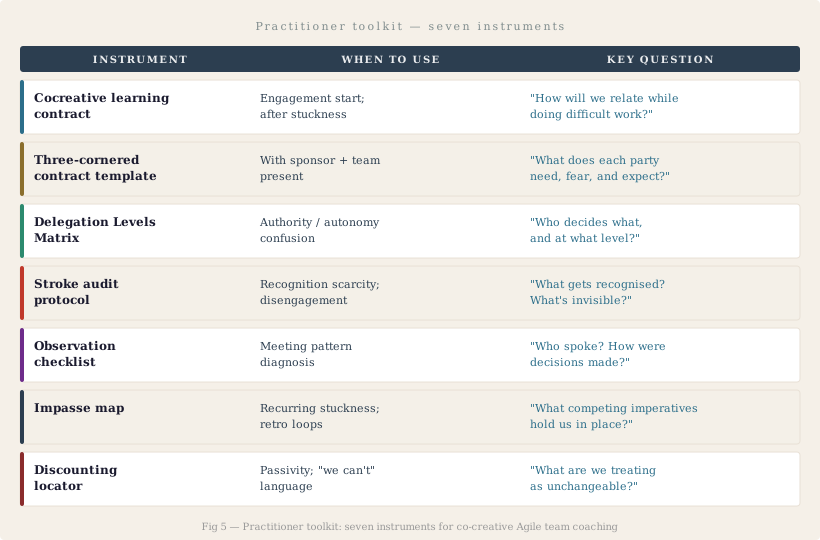
    Co‑creative TA concepts need to be translated into concrete coaching moves that practitioners can use without TA certification. A useful discipline is to reduce any TA concept to three questions:

    1. What pattern is emerging between us / within the team?
    2. What meaning are we co‑creating that keeps this pattern stable?
    3. What small change in contract, recognition, or decision rights would create a different pattern?

    These three questions operationalise the co‑creative stance: they locate the pattern in the field (not in individuals), treat meaning as co‑constructed (not imposed), and orient toward action (not interpretation).

    The following toolkit consolidates practical instruments referenced throughout this article:

    1

    Cocreative learning contract(adapted from Robinson, 2020)

    Used at engagement start or when re‑contracting after stuckness. Establishes psychological‑level conditions: shared responsibility, present‑centredness, explicit permissions to challenge, disagree, and make mistakes.

    2

    Three‑cornered contract template

    Completed with sponsor and team present. Includes: each party's success criteria, feared outcomes, confidentiality terms, reporting agreements, and a review schedule.

    3

    Delegation Levels Matrix

    Maps key team decisions onto a delegation spectrum (from Tell to Delegate). Completed collaboratively with team, manager, and sponsor. Revised periodically as trust and capability grow.

    4

    Stroke audit protocol

    A facilitated team exercise that maps what gets recognised, by whom, and what is invisible. Identifies where negative strokes substitute for missing positive ones. Produces specific experiments to redesign the recognition economy.

    5

    Observation checklist

    A structured form for the coach to track interaction patterns in meetings without labelling individuals: who spoke, who was interrupted, how decisions were made, when approval was sought versus when propositions were offered autonomously.

    6

    Impasse map

    A visual exercise for the team: identify two competing imperatives, the feared outcome if either wins, and what protection or contracting would be needed to move. Produces a shared artefact that makes the stuckness visible and legitimate.

    7

    Discounting locator

    The coach asks: 'What is the first thing we're treating as not real, not important, or not changeable?' Then designs the smallest action that acknowledges the discounted element — a direct request, a boundary conversation, a data‑gathering experiment.

    Practitioner toolkit: seven instruments for co‑creative TA coaching
    Figure 5 — Practitioner toolkit: seven instruments

    11. Boundary Conditions and Honest Limitations

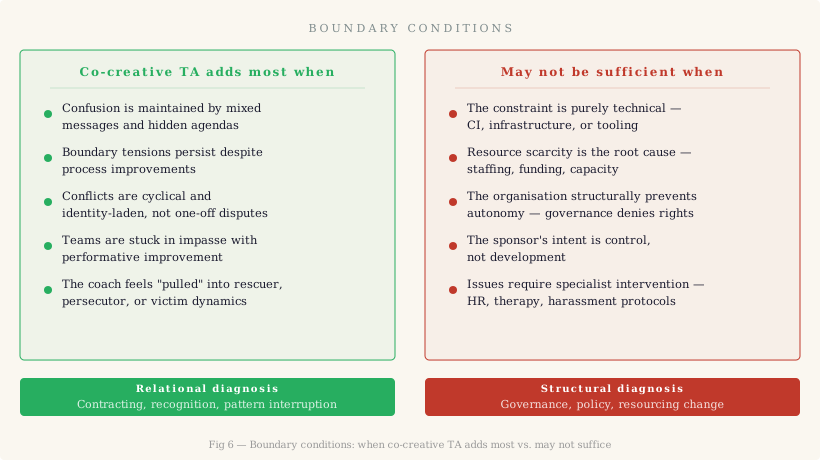
    Intellectual honesty requires naming the limits of any framework. Co‑creative TA is a powerful relational lens, but it does not substitute for structural change, resourcing decisions, or technical capability building.

    Co‑creative TA adds most when:

    • Confusion is maintained by mixed messages, hidden agendas, and covert expectations
    • Boundary tensions persist despite process improvements, suggesting relational stabilisation
    • Conflicts are cyclical and identity‑laden rather than one‑off disputes
    • Teams are stuck in impasse with performative improvement
    • The coach feels "pulled" into rescuer, persecutor, or victim dynamics and needs language for what is happening

    Co‑creative TA may not be sufficient when:

    • The constraint is purely technical — CI pipeline instability, infrastructure debt, or tooling limitations are not relational problems
    • Resource scarcity is the root cause — no amount of recognition redesign will substitute for adequate staffing or funding
    • The organisation structurally prevents autonomy — governance denies decision rights, compliance requires approval chains — and "dependency" is adapted realism, not a team defect
    • The sponsor's intent is control rather than development — the coaching engagement is structurally incoherent, and the ethical response may be to renegotiate or exit
    • Issues require specialist intervention — diagnosed mental health conditions, bullying, or harassment require HR involvement and professional therapeutic support, not coaching
    Boundary conditions: when co‑creative TA adds most vs. may not suffice
    Figure 6 — Boundary conditions: when co‑creative TA adds most vs. may not suffice

    Organisational TA explicitly insists on diagnosis at both personal and system levels (Mohr & Steinert). This insistence is a safeguard against the most common misuse of relational frameworks in organisations: psychologising structural problems. When a team is "dependent" because it genuinely lacks decision authority, telling it to "take more ownership" is not coaching; it is gaslighting. The responsible move is to diagnose whether the constraint is relational (and therefore addressable through contracting, recognition work, or pattern interruption) or structural (and therefore requiring governance, policy, or resourcing change) — and to advocate for the latter when needed.

    12. Measuring Progress

    Relational interventions are often dismissed as "soft" because practitioners do not measure them. This is a mistake of omission, not a limitation of the work itself. TA‑informed coaching can and should be paired with concrete metrics.

    Leading indicators (proximal signals that relational patterns are shifting):

    • Decision latency: time from issue raised to decision made, before and after intervention
    • Escalation rate: percentage of decisions made within the team versus escalated to management
    • Blocked item duration: average time items sit in "waiting for approval" or "blocked" status
    • Unsolicited improvement proposals: count of improvement ideas raised by team members without prompting
    • Initiative‑to‑approval ratio: number of initiatives proposed by the team relative to how many required formal approval

    Lagging indicators (outcome measures, visible over weeks to months):

    • Cycle time and lead time: if autonomy increases, work should flow faster
    • Quality and rework rate: monitored to ensure autonomy is not compromising quality
    • Engagement and retention: pulse survey items such as "I feel I have ownership of my work" and "I feel safe to take risks"
    • Stakeholder feedback: qualitative feedback on team responsiveness and proactivity

    Evaluation cadence. A 4–12 week cycle with baseline measurement, midpoint review, and final assessment. Narrative vignettes — "before and after" stories — provide qualitative evidence that enriches the quantitative picture. The combination of hard numbers and human stories gives stakeholders a complete picture and the coach a feedback loop for adjusting interventions.

    13. The Evidence Gap — and an Invitation

    The evidence picture underpinning this article is uneven, and it would be dishonest to suggest otherwise. On one side, there is a rich body of co‑creative and organisational TA theory, strong adjacent research in organisational psychology (psychological safety, psychological contracts, coaching outcomes, working alliance), and a tradition of TA practitioner case work. On the other side, there is no well‑established body of empirical studies evaluating TA‑informed coaching interventions specifically in Agile or product delivery contexts. This gap mirrors the broader state of large‑scale Agile transformation research, which remains dominated by experience reports (Dikert et al., 2016).

    Several research directions could move the field forward:

    Three‑cornered contracting studies. Multi‑case studies examining how explicit three‑cornered contracting (versus standard coaching agreements) affects coaching outcomes, sponsor satisfaction, and the persistence of covert conflicts.

    Recognition economy and psychological safety. Mixed‑methods studies measuring team‑level recognition patterns (using adapted stroke audit instruments) alongside standard psychological safety measures, testing whether the TA lens adds explanatory and predictive power beyond existing models.

    Discounting and decision latency. Intervention studies in enterprise product teams, measuring whether introducing discounting diagnostics and delegation matrices reduces decision latency and increases team‑level initiative.

    Coach entanglement and supervision. Qualitative studies examining how coach supervision (versus unsupervised practice) affects coaches' ability to manage triangulation, maintain contracting, and avoid entanglement in Agile team coaching contexts.

    Comparative designs. TA‑informed coaching versus standard Agile coaching in comparable organisational contexts, with measures of contracting clarity, authority enactment, covert conflict, and delivery outcomes.

    The invitation is not primarily to academics, though academic investigation is needed. It is to practising Agile coaches willing to systematise their observations, document their interventions, measure their outcomes, and submit their work to peer review. The co‑creative TA community and the Agile coaching community have much to offer each other — provided both are willing to engage with the other's standards of rigour.

    14. Conclusion: From Process to Relationship — and Back

    Co‑creative transactional analysis does not replace Agile practices. It deepens them. Ceremonies, roles, artefacts, and working agreements remain necessary. But they are not sufficient for the relational work that Agile's own premises demand. When a team is stuck, when retrospectives have become theatre, when dependency persists despite declared empowerment, when psychological safety is declared but not felt, the missing intervention is often not a better process but a more honest, disciplined attention to what is happening between people.

    Co‑creative TA provides language and methodology for that attention. Its contracting tools surface the hidden expectations that sabotage Agile engagements before they begin. Its stroke economy model operationalises psychological safety in terms more granular and actionable than norms and declarations. Its symbiosis and discounting frameworks reframe "lack of ownership" as a relational structure rather than a team defect. Its impasse and games analysis offers paths forward when continuous improvement has become performative. And its treatment of the coach as a field participant — not a neutral observer — keeps the coach honest about their own contribution to the dynamics they are trying to shift.

    Robinson's (2020) insight about cocreative learning environments offers a fitting closing image. When his participants reflected on what had enabled their transformational change, they identified not only what was present in the space (safety, permissions, OKness, integrating Adult transactions) but what was deliberately absent (judgment, discounting, negative games, one‑upmanship, drama). The discipline of co‑creative TA is, at its core, a discipline of relational hygiene — attending carefully to what the coach brings into the team's field, what the coach helps keep out, and what the team discovers it can create for itself when the conditions are right.

    The Agile promise was never just about faster delivery. It was about a different way of working together — more humane, more adaptive, more honest. Co‑creative TA offers Agile team coaches a more precise and more humble instrument for making that promise real.

    References

    Adkins, L. (2010). Coaching Agile teams: A companion for ScrumMasters, Agile coaches, and project managers in transition. Addison-Wesley.

    Appelo, J. (2011). Management 3.0: Leading Agile developers, developing Agile leaders. Addison-Wesley.

    Berne, E. (1961). Transactional analysis in psychotherapy. Grove Press.

    Berne, E. (1964). Games people play: The psychology of human relationships. Penguin Books.

    Dikert, K., Paasivaara, M., & Lassenius, C. (2016). Challenges and success factors for large-scale agile transformations: A systematic literature review. Journal of Systems and Software, 119, 87–108.

    Edmondson, A. (1999). Psychological safety and learning behavior in work teams. Administrative Science Quarterly, 44(2), 350–383.

    English, F. (1975). The three-cornered contract. Transactional Analysis Journal, 5(1), 383–384.

    Erskine, R. G., & Zalcman, M. J. (1979). The racket system: A model for racket analysis. Transactional Analysis Journal, 9(1), 51–59.

    Graßmann, C., Schölmerich, F., & Schermuly, C. C. (2020). The relationship between working alliance and client outcomes in coaching: A meta-analysis. Human Relations, 73(1), 35–58.

    Harris, T. A. (1969). I'm OK — You're OK. Harper & Row.

    Hawkins, P. (2017). Leadership team coaching: Developing collective transformational leadership (3rd ed.). Kogan Page.

    Hay, J. (1995). Donkey bridges for developmental TA. Sherwood Publishing.

    Karpman, S. (1968). Fairy tales and script drama analysis. Transactional Analysis Bulletin, 7(26), 39–43.

    Mellor, K. (1980). Impasses: A developmental and structural understanding. Transactional Analysis Journal, 10(3), 213–220.

    Mellor, K., & Schiff, E. (1975). Discounting. Transactional Analysis Journal, 5(3), 295–302.

    Mezirow, J., & Associates. (2000). Learning as transformation: Critical perspectives on a theory in progress. Jossey-Bass.

    Mohr, G., & Steinert, T. (Eds.). Organisational transactional analysis: Contributions to professional and societal development.

    Mountain, A., & Davidson, C. (2011). Working together: Organizational transactional analysis and business performance. Gower.

    Petriglieri, G. (2007). Stuck in a moment: A developmental perspective on impasses. Transactional Analysis Journal, 37(3), 185–194.

    Robinson, P. (2020). Cocreative transformational learning as a way to break out of script. Transactional Analysis Journal, 50(1), 41–55.

    Rogers, C. R. (1969). Freedom to learn. Charles E. Merrill Publishing.

    Rousseau, D. M. (1995). Psychological contracts in organizations: Understanding written and unwritten agreements. Sage.

    Schiff, J. (1975). Cathexis reader: Transactional analysis treatment of psychosis. Harper & Row.

    Schmid, B. (2008). The role concept of transactional analysis and other approaches to personality, encounter, and cocreativity for all professional fields. Transactional Analysis Journal, 38(1), 17–30.

    Schwaber, K., & Sutherland, J. (2020). The Scrum Guide. Scrum.org.

    Steiner, C. M. (1990). Scripts people live: Transactional analysis of life scripts. Grove Press. (Original work published 1974.)

    Summers, G., & Tudor, K. (2000). Cocreative transactional analysis. Transactional Analysis Journal, 30(1), 23–40.

    Thorgren, S., & Caiman, E. (2019). The role of psychological safety in implementing agile methods across cultures. Research-Technology Management, 62(2), 31–39.

    Tudor, K., & Summers, G. (2014). Co-creative transactional analysis: Papers, responses, dialogues and developments. Karnac Books.

    von Glasersfeld, E. (1990). An exposition of constructivism: Why some like it radical. In R. B. Davis, C. A. Maher, & N. Noddings (Eds.), Constructivist views on the teaching and learning of mathematics (pp. 19–29). National Council of Teachers of Mathematics.

    Roman Lobus·Singapore·7 April 2026