Stop the Drama: Coaching Teams Out of Psychological Games
A diagnosis-first guide to spotting live game patterns in Agile work, seeing the payoff, and deciding whether the drama lens is actually the right one.
The meeting that stops being about the work
A sprint review turns tense. A leader presses on a miss, the Product Owner defends, an engineer over-explains, and the Scrum Master starts translating between people who should be speaking more directly. Three minutes later the room is no longer working on a delivery problem. It is managing anxiety in public.
This article owns that moment. Its job is diagnostic: help you recognize a live game pattern, understand why it repeats, and decide whether the drama lens is actually the right one. Tactical wording lives in Exit Ramps, not here.
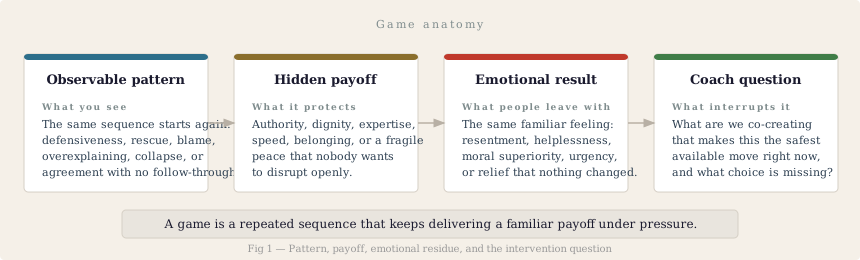
What makes a conflict a game
Not every tense interaction is a game. A game is a recurring pattern that repeatedly buys the group something: lowered embarrassment, preserved authority, maintained innocence, or a way to release pressure without changing the setup. The clue is not just the heat. It is the familiarity.
That is why the best first move is to think in pattern, not personality. The question is not who is toxic. The question is what sequence the room already knows how to run.
Four recurring patterns worth naming
Faux Consensus
The room sounds aligned, but no one has named what they will lose if the change becomes real.
Executive Proxy
Pressure arrives through the nearest legitimate role instead of through the person who actually owns it.
Hero-Martyr Sprint
Visible sacrifice produces relief and admiration while the underlying capacity problem remains untouched.
Yes, But Delivery
Every idea receives polite agreement first and practical cancellation second.
These patterns matter because they disguise structural contradictions as interpersonal difficulty. A team sounds dramatic when it is actually trying to preserve status, dodge an impossible commitment, or negotiate missing authority indirectly.
Once the payoff becomes visible, the coach can stop moralizing the scene and start deciding whether the next need is observation, clearer authority, or a direct conversation somewhere else.
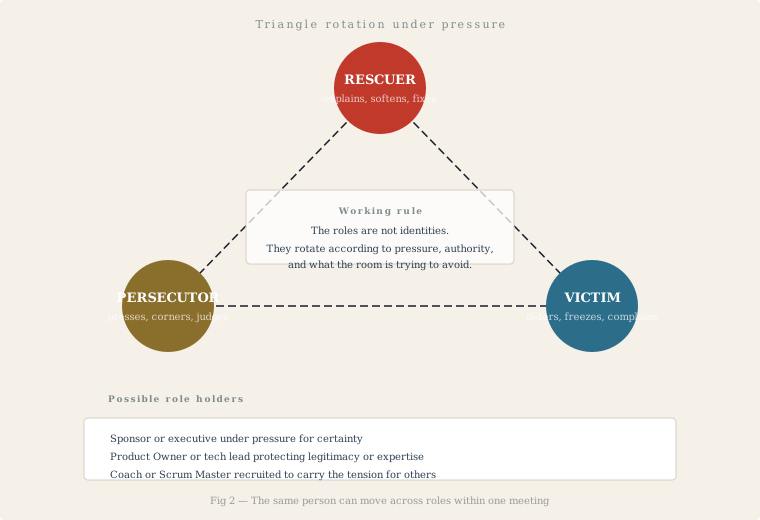
How to recognize the pattern before it hardens
The emotional tone changes faster than the content justifies.
People start speaking as fixed roles instead of as contributors to a shared task.
The coach feels pulled to rescue, translate, or keep the peace at any cost.
The same sequence has happened before under slightly different topics.
The coach's internal pull is part of the diagnostic. If you suddenly want to rescue, explain, translate, or smooth over the exchange, that feeling may be evidence that the room is trying to recruit you into its preferred stabilizing role.
Treat that pull as data, not as a command.
What diagnostic interruption sounds like
A diagnostic interruption should slow the sequence without pretending to solve it. The aim is to make the pattern visible enough that the room can stop replaying it unconsciously.
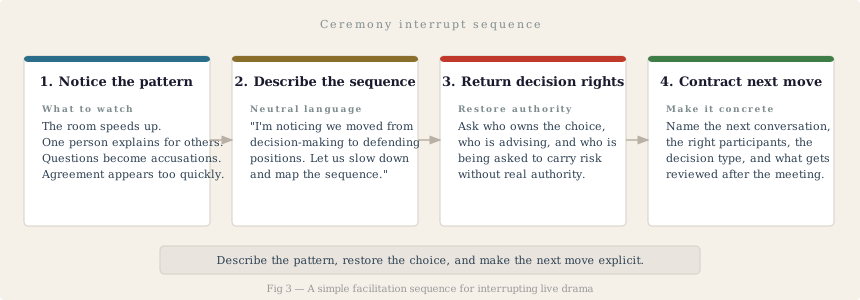
"Before we decide who is right, can we slow down and map the sequence we are replaying?"
"What choice is still live here that we keep circling instead of naming?"
When not to use the lens
Do not use the drama lens to make obvious structural reality sound emotionally sophisticated. If the team lacks budget, authority, or staff, a game reading may be secondary to the more basic truth that the setup is untenable.
The lens earns its place when the same sequence keeps recurring after reasonable process and setup fixes. If you mainly need tactical phrases, switch to Exit Ramps.
Continue Exploring
Go deeper into the work
The Book
The Art of Creating Self-Organizing Teams
The full framework behind this article — contracting, team dynamics, and practical coaching tools for every stage of the journey.
Companion Toolkit
Resistance Radar & Resilience Scorecard
Practical tools for mapping resistance patterns and measuring whether interventions increased capacity — not just compliance.
TA for Agile
Co-creative TA in Agile Contexts
Ego states, psychological contracts, group imago, and the relational concepts that underpin this article — applied to real teams.