Task Leadership, Anxiety Leadership, Learning Leadership
Agile teams confuse three kinds of leadership: coordinating work, managing anxiety, and enabling learning. Self-organisation fails when anxiety leadership silently takes over and everyone mistakes the fastest calming move for mature leadership.
A familiar Agile scene
The team says it is self-organising. In practice, the senior engineer decides technical direction, the Scrum Master calms the room whenever conflict appears, and the product owner becomes the person everyone follows when stakeholder anxiety rises.
No one is formally abusing authority. Different kinds of leadership are moving around the group, and the team has only one word for all of them.
1. Three leadership and followership systems
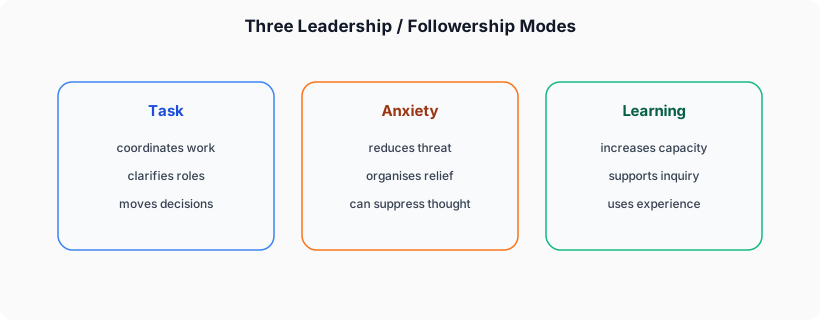
Landaiche distinguishes task leadership, anxiety leadership, and learning leadership. Each is real. Each can be useful. Problems arise when the team confuses them.
Task leadership coordinates work. Anxiety leadership organises the group around threat and relief. Learning leadership helps the group mature, think, and use experience. Agile teams need all three, but self-organisation decays when anxiety leadership silently governs the others.
2. How anxiety leadership takes over
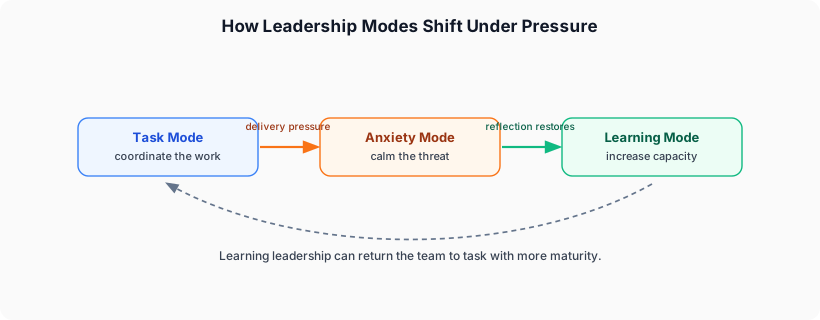
Under pressure, the team follows whoever can reduce discomfort fastest. That person may be the senior engineer with certainty, the Scrum Master with reassurance, the product owner with stakeholder access, or the coach with interpretation.
The danger is that relief feels like leadership. The room settles, but the team's capacity does not grow. The group has followed anxiety out of the room instead of following learning deeper into the work.
The fastest speaker becomes the apparent decision maker.
The person who reassures the sponsor becomes more influential than the person with the best evidence.
Conflict is resolved by calming it rather than understanding it.
The team calls the outcome alignment because the room feels quieter.
3. Coaching the distinction
The coach can ask, 'What kind of leadership does this moment need?' That question is often enough to separate coordination from anxiety management. If the team needs task leadership, clarify decision rights. If it needs anxiety containment, name the threat. If it needs learning leadership, slow the room and ask what the experience is teaching.
This also dignifies followership. Mature followership is not passivity. It is the choice to support the lead that best serves the work at this moment.
4. Boundary note
Do not use anxiety leadership to shame the person who calms the room. That person may be carrying a necessary function. The question is whether the function remains useful or has become the team's substitute for learning.
Where To Go Next
Read this to connect leadership function with formal and informal authority.
Use this as the wider conceptual map for the Transactional Analysis pathway.
Continue Exploring
Go deeper into the work
The Book
The Art of Creating Self-Organizing Teams
The full framework behind this article — contracting, team dynamics, and practical coaching tools for every stage of the journey.
Companion Toolkit
Resistance Radar & Resilience Scorecard
Practical tools for mapping resistance patterns and measuring whether interventions increased capacity — not just compliance.
TA for Agile
Co-creative TA in Agile Contexts
Ego states, psychological contracts, group imago, and the relational concepts that underpin this article — applied to real teams.