Engaged Research: The Coach as Practitioner-Researcher
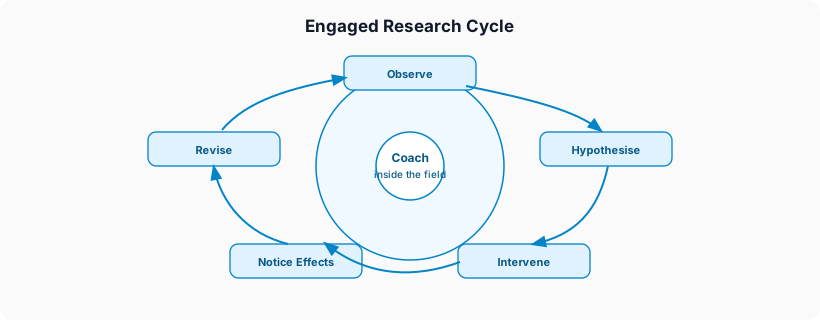
Coaching becomes more credible when it stops pretending to be either neutral observation or heroic intervention. The coach enters the team as an engaged researcher: observing, hypothesising, intervening, noticing effects, and revising the working theory in public enough that the team learns how inquiry works.
A familiar Agile scene
A coach begins a twelve-week engagement with a careful plan: stakeholder interviews, working agreements, conflict mapping, facilitation practice. By week four, the plan is already partly wrong. The team has not resisted the coaching. It has revealed a different problem than the one the sponsor described.
The coach can defend the plan, improvise without a theory, or treat the plan as a hypothesis. The third option is the discipline Landaiche calls engaged researching.
1. The coach is inside the data
Engaged research rejects two comforting fantasies. The first is that the coach can stand outside the system as a neutral observer. The second is that the coach's feelings and participation are automatically wisdom. The coach is involved, affected, and responsible for thinking carefully about that involvement.
For Agile coaching, this matters because the field is under pressure to prove value. A research stance gives the coach a way to make practice more disciplined without pretending that team coaching can be reduced to a recipe.
2. Plans become hypotheses
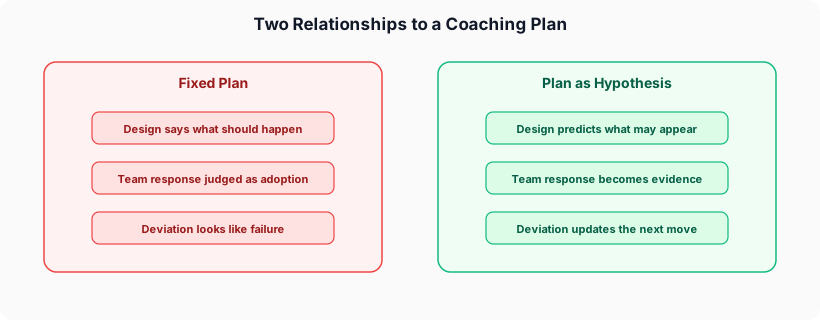
A coaching plan is not a promise about what will happen. It is a theory about what this team may need next. Once the coach treats the plan this way, deviation becomes evidence rather than failure.
This stance also changes contracting. The coach can say to the sponsor and team: 'Here is the working hypothesis. Here is what would confirm it. Here is what would make us revise it.' That is more honest than selling certainty and more useful than vague emergence language.
Name what you think is happening before you intervene.
Define what you expect the intervention to make more visible.
Watch the team's response as data, not as compliance or noncompliance.
Revise the hypothesis openly enough that the team learns the method.
3. The intervention is also a measurement
A retrospective format, a one-to-one conversation, a sponsor re-contracting session, or a silence held for ten seconds all produce data. The question is not only whether the move worked. It is what the move revealed about the group's current capacity.
This gives coaches a practical answer to the measurement gap in Agile coaching. Not all value can be counted immediately, but every serious intervention should sharpen what the coach and team can now see.
4. Boundary note
Engaged research is not permission to experiment on people without consent. The contract must make the inquiry explicit: what is being examined, who owns the learning, what will be shared with the sponsor, and what remains confidential to the team.
Where To Go Next
Use this as the wider conceptual map for the Transactional Analysis pathway.
Use this companion piece when the inquiry needs to be translated into impact evidence.
Continue Exploring
Go deeper into the work
The Book
The Art of Creating Self-Organizing Teams
The full framework behind this article — contracting, team dynamics, and practical coaching tools for every stage of the journey.
Companion Toolkit
Resistance Radar & Resilience Scorecard
Practical tools for mapping resistance patterns and measuring whether interventions increased capacity — not just compliance.
TA for Agile
Co-creative TA in Agile Contexts
Ego states, psychological contracts, group imago, and the relational concepts that underpin this article — applied to real teams.