The Learning Community Agile Forgot
Agile promised learning organisations. Many implementations became delivery systems with learning language attached. A learning community has a higher standard: shared inquiry, peer correction, transmission across generations, and permission to revise the paradigm.
A familiar Agile scene
The organisation has communities of practice, guilds, retrospectives, lunch-and-learns, and a transformation office. Everyone can point to learning activity. Yet when a new team forms, it repeats the same avoidable mistakes the previous teams made two years ago.
The organisation has learning events. It does not yet have a learning community.
1. A learning community is not a content channel
For Landaiche, a learning community is a human grouping whose primary objective is engagement with ongoing learning. It supports learning for individual members and for the group as a whole. That is stronger than a knowledge base, a guild calendar, or a retrospective habit.
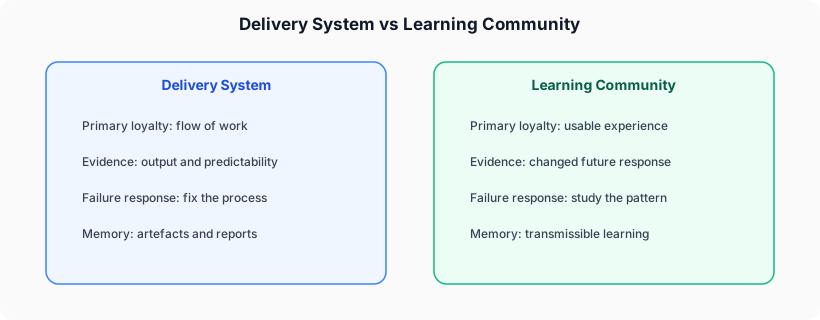
A delivery system asks how work moves. A learning community asks how experience becomes usable across people, roles, teams, and generations. Agile often promised the second and implemented the first.
2. What makes the community real
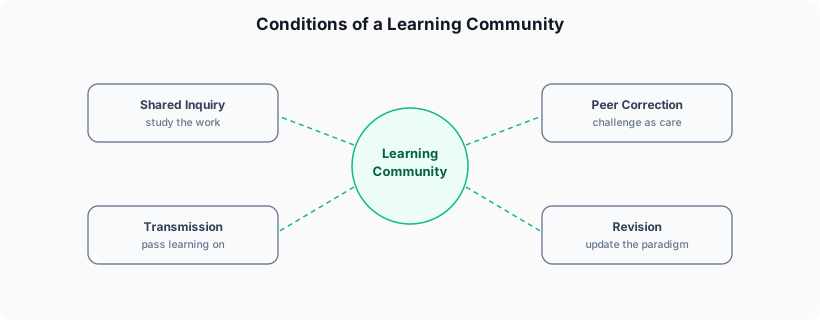
A learning community has memory, correction, transmission, and permission to revise its own paradigm. It lets newer members inherit what the group has learned without freezing that learning into dogma.
This is where Transactional Analysis matters for Agile. TA has always carried a practical interest in contracts, group culture, scripts, games, and learning. Used well, it gives a community language for examining its own process, not only improving its delivery mechanics.
Shared inquiry: members study the work, not only report status.
Peer correction: challenge is treated as care for the community's learning.
Transmission: lessons are passed to new members without becoming unquestionable rules.
Revision: the community can update its own assumptions when experience disproves them.
3. The coach's contribution
The coach should not become the community's memory. The coach helps the community build ways to remember, test, and transmit its own learning. That may mean changing how retrospectives are archived, how guilds examine failed experiments, or how new teams inherit prior learning without being forced into imitation.
The strongest sign of success is not that teams quote the coach. It is that teams can argue with inherited practice intelligently because they understand why it existed.
4. Boundary note
A learning community still needs boundaries. Not every organisational issue belongs in every community space. The coach should help distinguish learning that can be shared openly, learning that belongs to a team contract, and material that requires sponsor or HR channels.
Where To Go Next
Use this as the wider conceptual map for the Transactional Analysis pathway.
Return to the first article when the problem is local group nonlearning rather than community design.
Continue Exploring
Go deeper into the work
The Book
The Art of Creating Self-Organizing Teams
The full framework behind this article — contracting, team dynamics, and practical coaching tools for every stage of the journey.
Companion Toolkit
Resistance Radar & Resilience Scorecard
Practical tools for mapping resistance patterns and measuring whether interventions increased capacity — not just compliance.
TA for Agile
Co-creative TA in Agile Contexts
Ego states, psychological contracts, group imago, and the relational concepts that underpin this article — applied to real teams.