The Team That Cannot Learn
Some Agile teams do not fail because they lack process, discipline, or motivation. They fail because the group cannot integrate new experience. The same sprint evidence returns, the same retrospective insight is rediscovered, the same defensive explanation protects the same stuck pattern. The team is busy, but it is not learning.
A familiar Agile scene
The team has run the same retrospective three times in six months. The words change, but the discovery is identical: we overcommit, we hide bad news until late, and we wait for the lead engineer to decide before anyone else risks a view.
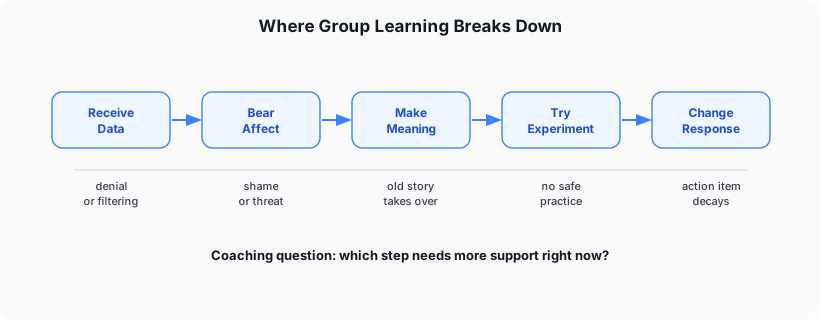
Each time the team leaves with sensible actions. Each time the actions decay by the next sprint review. Nothing is being ignored exactly. Something more troubling is happening: the group is receiving experience without integrating it.
1. Learning is more than new information
Landaiche treats learning as the integration of experiential data. A group learns when it can take in what happened, metabolise the emotional and practical meaning of it, and change its future responsiveness. That is different from capturing an action item or agreeing that a problem exists.
An Agile team can therefore be extremely active and still be a nonlearning group. It can produce metrics, run ceremonies, and adopt vocabulary while the same unintegrated experience keeps returning. The evidence is present, but the group has no usable way to digest it.
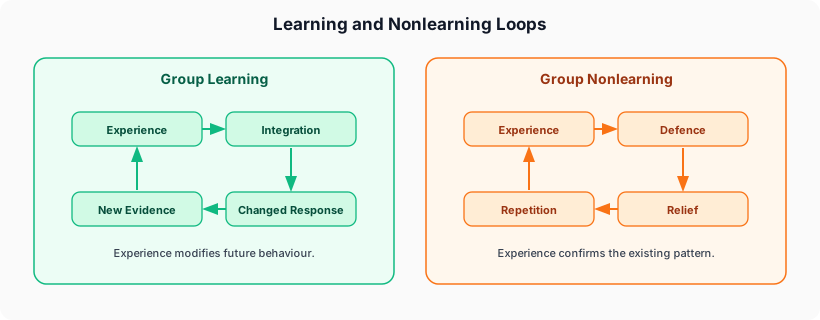
2. What nonlearning looks like in Agile work
The first sign is not incompetence. It is disproportion. A small production incident produces a full governance theatre. A mild disagreement becomes a threat to team unity. A clear piece of customer evidence is treated as noise because it would require a change in identity.
The second sign is rediscovery. The team keeps arriving at insights it has already had. This is not a memory problem. It means the insight never became part of the group's operating structure.
Retrospectives repeatedly surface the same theme with no increase in specificity.
Working agreements are remembered as artefacts but not used as live commitments.
The team explains failure faster than it examines what the failure requires it to learn.
A coach, Scrum Master, or manager becomes the container for learning the team has not internalised.
3. How coaches can intervene
The coach's first move is to slow the conversion of evidence into familiar explanation. Instead of asking what action the team wants to take, ask what the team has learned before and not yet used. This changes the object of attention from the event to the group's learning process.
The second move is to make repetition visible without accusation. A phrase such as, 'I think this is the third time this team has discovered this pattern; what stops it becoming usable knowledge?' keeps responsibility with the group without turning the group into a patient.
4. Boundary note
Calling a team nonlearning can become a sophisticated insult if the coach uses it as a label. Use the concept as a working hypothesis about the group's current capacity, not as a diagnosis of its character. The practical question is always: what condition would let this group integrate one more piece of reality than it could integrate last sprint?
Where To Go Next
Use this as the wider conceptual map for the Transactional Analysis pathway.
Read this when the question becomes how to embed reflection structurally.
Continue Exploring
Go deeper into the work
The Book
The Art of Creating Self-Organizing Teams
The full framework behind this article — contracting, team dynamics, and practical coaching tools for every stage of the journey.
Companion Toolkit
Resistance Radar & Resilience Scorecard
Practical tools for mapping resistance patterns and measuring whether interventions increased capacity — not just compliance.
TA for Agile
Co-creative TA in Agile Contexts
Ego states, psychological contracts, group imago, and the relational concepts that underpin this article — applied to real teams.