The Shared Bodymind of the Team
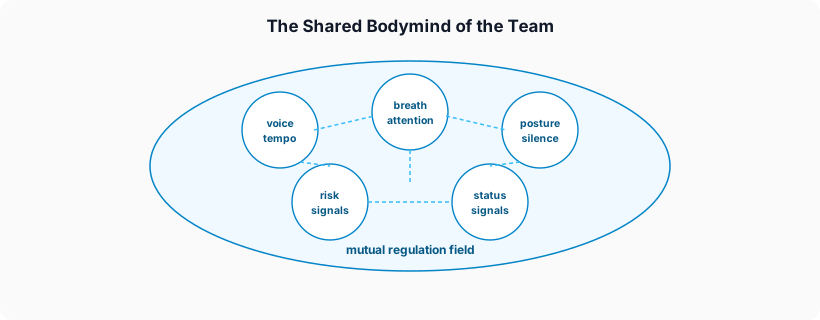
A team is not just individual minds exchanging information. It is a mutually regulating field of bodies, signals, tempo, silence, and affect. Coaches miss half the data when they listen only to words and Jira events.
A familiar Agile scene
The standup is technically fine. Everyone answers the three questions. No blockers are named. Yet the coach notices the same thing every day: clipped voices, cameras off after one manager joins, a pause before the tester speaks, and a sudden speed-up whenever release risk appears.
Nothing in the transcript proves the pattern. The group body is still saying something.
1. The unit is not only the individual
Landaiche's shared bodymind names the way people in groups regulate and affect one another below the level of explicit speech. Teams breathe, tense, rush, avoid, and settle together. This is not mystical. It is ordinary human responsiveness in a work setting.
Agile coaching often privileges visible process data: board flow, meeting outputs, decisions, and metrics. Those matter. But the coach also needs to read tempo, silence, posture, interruption, energy loss, and what changes when specific roles enter the room.
2. What remote work removes
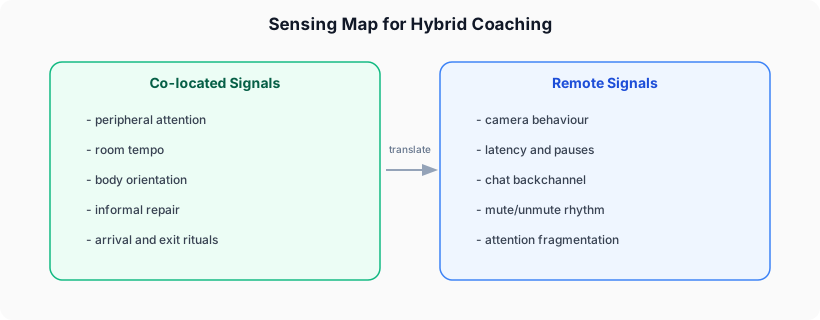
Remote work does not eliminate the shared bodymind. It compresses and distorts it. The coach loses peripheral vision, small bodily shifts, arrival rituals, side conversations, and the room's felt temperature. New signals appear instead: latency, camera behaviour, chat backchannels, response timing, and the rhythm of mute/unmute.
This matters because many post-pandemic teams are not simply missing office culture. They are missing parts of the sensing system through which trust, threat, and readiness used to be regulated.
3. How to use embodied data responsibly
Embodied data should be offered as hypothesis, never as certainty. 'I noticed the pace changed when release risk came up; did anyone else notice that?' is usable. 'The team is anxious' may be too interpretive and too exposing.
Good coaching helps the team develop its own capacity to notice bodily and relational signals. The coach lends attention temporarily so that the group can eventually read itself.
Track shifts in tempo when specific topics appear.
Notice who regulates the room by speaking, joking, summarising, or going silent.
Compare what the group says with what the group does immediately after saying it.
Use tentative language that lets the team confirm, correct, or reject the observation.
4. Boundary note
Embodied observation can become intrusive if the coach treats bodies as evidence to decode. Stay with observable interactional effects. The team owns the meaning of its signals; the coach contributes disciplined noticing.
Where To Go Next
Read this for a deeper treatment of online containment.
Use this as the wider conceptual map for the Transactional Analysis pathway.
Continue Exploring
Go deeper into the work
The Book
The Art of Creating Self-Organizing Teams
The full framework behind this article — contracting, team dynamics, and practical coaching tools for every stage of the journey.
Companion Toolkit
Resistance Radar & Resilience Scorecard
Practical tools for mapping resistance patterns and measuring whether interventions increased capacity — not just compliance.
TA for Agile
Co-creative TA in Agile Contexts
Ego states, psychological contracts, group imago, and the relational concepts that underpin this article — applied to real teams.