Social Pain in Agile Teams
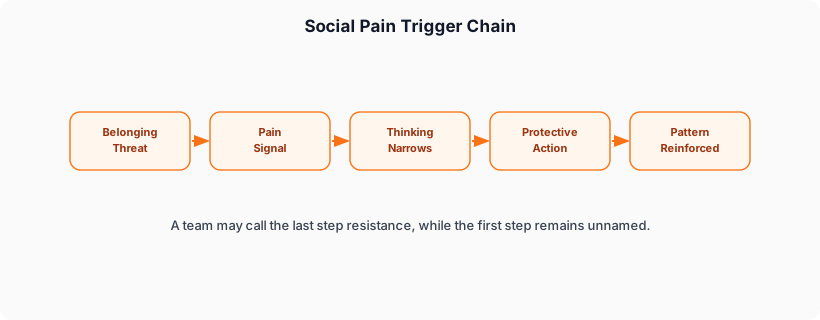
Exclusion, humiliation, rejection, and loss of belonging do not arrive in teams as abstract cultural issues. They register as pain. Many patterns coaches call resistance, defensiveness, or drama are social pain responses before they are attitude problems.
A familiar Agile scene
In planning, a tester says the release risk is higher than the board suggests. The product manager sighs, the engineering lead says, 'We have been over this,' and the room moves on. The tester says little for the rest of the meeting.
Later the team describes the tester as disengaged. A coach reading for social pain sees another possibility: the team has just taught one member that bringing reality into the room risks exclusion.
1. Belonging can hurt
Landaiche draws on social pain research to explain why rejection, humiliation, exclusion, and threatened separation can produce reactions that look extreme from the outside. If belonging is experienced as necessary for survival, the threat of losing it is not a soft issue. It is a pain signal.
Agile teams create these signals constantly. A ignored warning, a joke after a vulnerable admission, a decision made outside the room, or a sponsor's visible impatience can all teach the group what speech costs.
2. Resistance may be pain protection
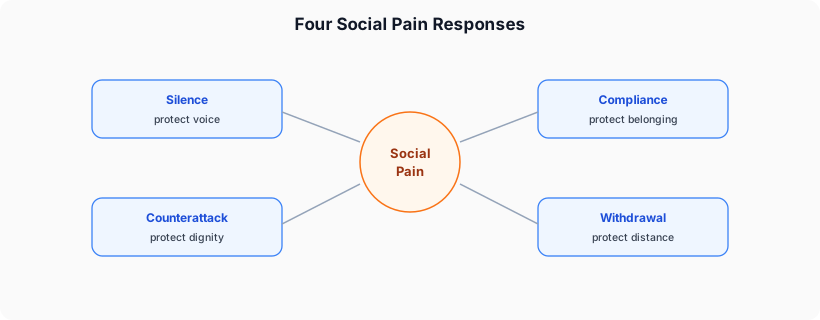
A person who withdraws after being dismissed may be protecting dignity. A subgroup that becomes sarcastic after repeated exclusion may be protecting belonging. A team that performs agreement in front of leadership may be protecting itself from the pain of public contradiction.
This does not make every reaction justified. It changes the coach's first question. Instead of 'How do we reduce resistance?' ask, 'What pain would become exposed if this resistance stopped working?'
Silence after a failed risk disclosure is data about consequence.
Sarcasm may indicate that direct protest has become too expensive.
Over-compliance can be a belonging strategy, not commitment.
Counterattack often protects against shame before it expresses conviction.
3. Coaching without becoming therapeutic
The coach does not need to process personal trauma to work responsibly with social pain. The work is to reduce unnecessary social threat in the team system so that reality can be spoken and used.
Practical moves include naming interactional cost, slowing public correction, protecting dissent from immediate evaluation, and helping leaders repair after dismissive responses. These are organisational moves with psychological consequences.
4. Boundary note
Social pain is a useful organisational lens, not a licence to diagnose people's nervous systems in public. Keep the language behavioural: what happened, what it cost, what the group learned, and what condition would make the next truthful contribution less expensive.
Where To Go Next
Read this for the organisational gap between declared and experienced safety.
Use this as the wider conceptual map for the Transactional Analysis pathway.
Continue Exploring
Go deeper into the work
The Book
The Art of Creating Self-Organizing Teams
The full framework behind this article — contracting, team dynamics, and practical coaching tools for every stage of the journey.
Companion Toolkit
Resistance Radar & Resilience Scorecard
Practical tools for mapping resistance patterns and measuring whether interventions increased capacity — not just compliance.
TA for Agile
Co-creative TA in Agile Contexts
Ego states, psychological contracts, group imago, and the relational concepts that underpin this article — applied to real teams.