When Feedback Hurts Too Much to Use
Retrospectives assume teams can metabolise feedback. But when feedback lands as shame, the team protects itself through silence, counterattack, compliance, or avoidance. The issue is not whether the feedback is true; it is whether the group can use it without losing belonging.
A familiar Agile scene
The retrospective format is solid. The team has data. The facilitator asks what did not work. Someone says, 'The API work was late because backend did not tell us the contract changed.' The backend engineer stiffens and explains for five minutes why this is unfair.
The facilitator pushes for action items. The team produces one: communicate earlier. Everyone knows it is too vague. Nobody wants to touch the pain underneath the feedback.
1. Feedback must be metabolised
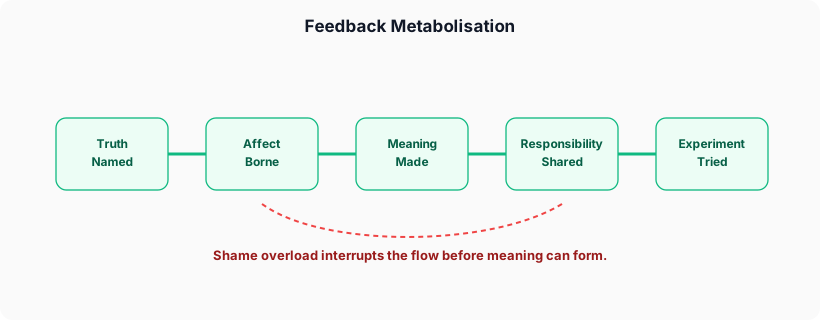
Teams often talk about feedback as if truth simply needs to be delivered. Landaiche's learning frame suggests a harder standard: feedback has to be received, emotionally borne, made meaningful, and converted into a changed response.
When feedback lands as shame, the metabolising process stops. The team may still create an action item, but the action item functions as relief from exposure rather than learning from experience.
2. Four defensive feedback responses
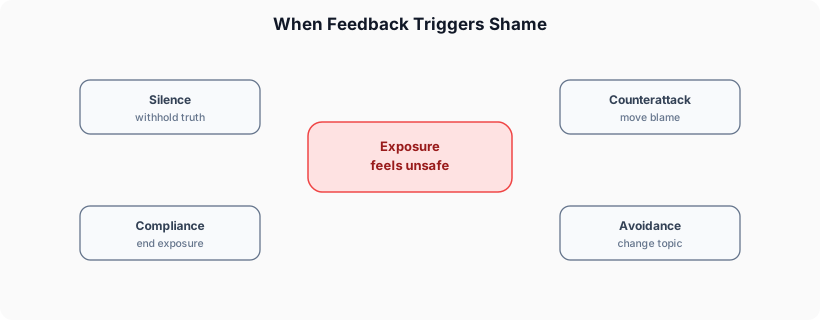
A team in shame does not always look emotional. It may look tidy, rational, efficient, or aligned. The defensive move is whatever reduces the exposure fastest.
The coach's task is not to remove discomfort. The task is to keep discomfort within the range where thinking remains possible.
Silence: the team protects belonging by withholding the real observation.
Counterattack: the recipient protects dignity by making the giver the problem.
Compliance: the group agrees quickly so the exposure can end.
Avoidance: the team moves to process detail before the meaning is touched.
3. Lower the shame load, not the truth
The common mistake is to soften the feedback until nothing true remains. A better move is to change the conditions around the truth. Make the observation specific, separate impact from blame, invite the recipient to add context, and keep the question on the shared work.
The facilitator might say: 'Let's hold this as a system observation first. The contract changed and the dependency surfaced late. Before we locate fault, what did each role know, not know, and need?' This protects learning without protecting the team from reality.
4. Boundary note
Do not use shame language as a public interpretation of an individual. The safer and more useful frame is the team's capacity to use difficult feedback. The coach owns the design of the conversation, not the inner life of the person receiving feedback.
Where To Go Next
Use this as the wider conceptual map for the Transactional Analysis pathway.
Use this for practical language when feedback has already escalated.
Continue Exploring
Go deeper into the work
The Book
The Art of Creating Self-Organizing Teams
The full framework behind this article — contracting, team dynamics, and practical coaching tools for every stage of the journey.
Companion Toolkit
Resistance Radar & Resilience Scorecard
Practical tools for mapping resistance patterns and measuring whether interventions increased capacity — not just compliance.
TA for Agile
Co-creative TA in Agile Contexts
Ego states, psychological contracts, group imago, and the relational concepts that underpin this article — applied to real teams.